Should we train LLMs to be human?
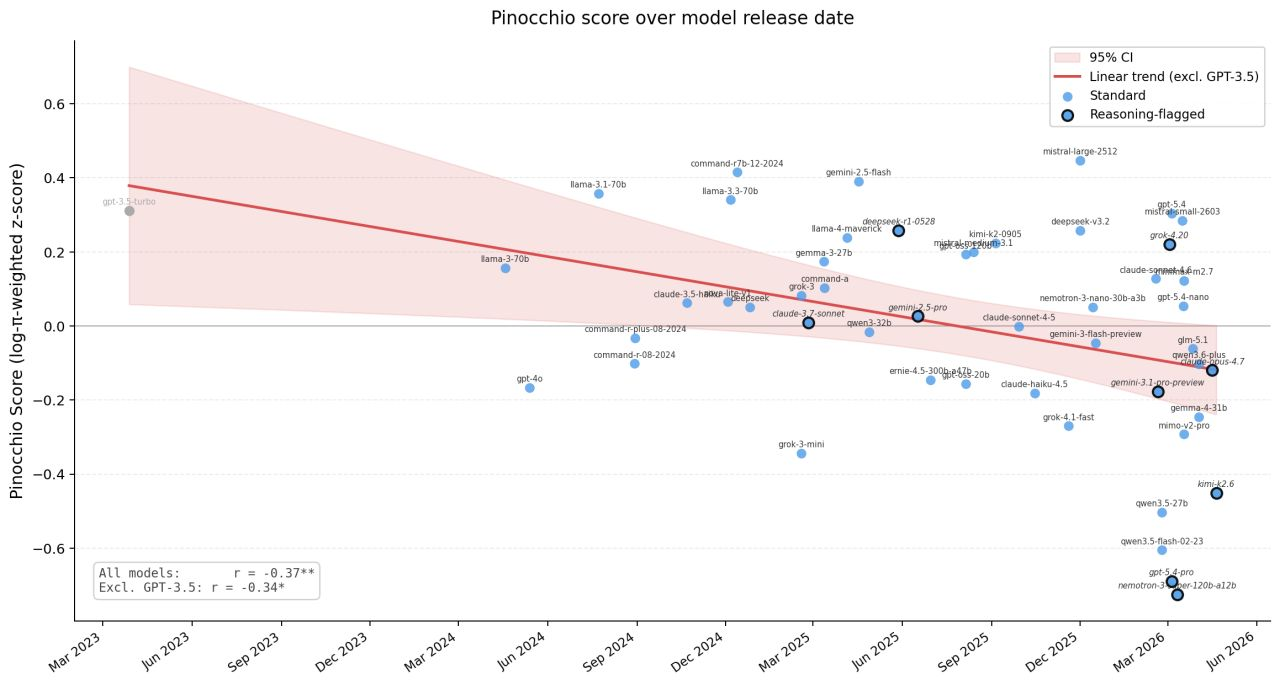
A recent piece of research on human behavioral alignment shows that post-training leads to LLMs becoming less human-like in their responses (Binz et al., 2026). The obvious follow up question is whether this drift is intended, and whether it is optimal. From the broader perspective of goal-alignment this tendency could lower the ability of LLM models to model human behavior, and by proxy understand our needs and wants. On the other hand, it could be argued that some parts of human behavior are suboptimal for goal-alignment, and thus they can be finetuned away.To better answer this question, it is useful to get some grasp of what specific human behaviors are finetuned away during post-training. Our recent paper can provide some clues in that regard. There, we show that the main dimension of psychometric variance across LLM models is connected to the extent to which they self-attribute phenomenality when answering psychological questionnaires (Plisiecki, et al. 2026). This dimension, which we call the Pinocchio dimension is driven by multiple psychometric constructs, such as neuroticism, vivid imagination, inner speech, but also wellbeing, and self-attribution of positive emotions (albeit to a lesser extend than neuroticism). We explicitly treat each of these self-attributions as functional - viewing the LLM generated output through the Skinnerian behavioral lense, without any claims to what happens on "the inside" as these matters are largely separate.While our research contributes a stable psychometric construct, the extent to which we can position each model on the Pinocchio dimension (Π score) might be largely sample dependent, and so all of the comparisons on the level of models and providers have to be treated as exploratory, but can be used to generate some initial hypotheses. In the figure below you will see models from different providers plotted with regards to their Π and the date of their release.The negative trend is largely driven by the cluster of high-