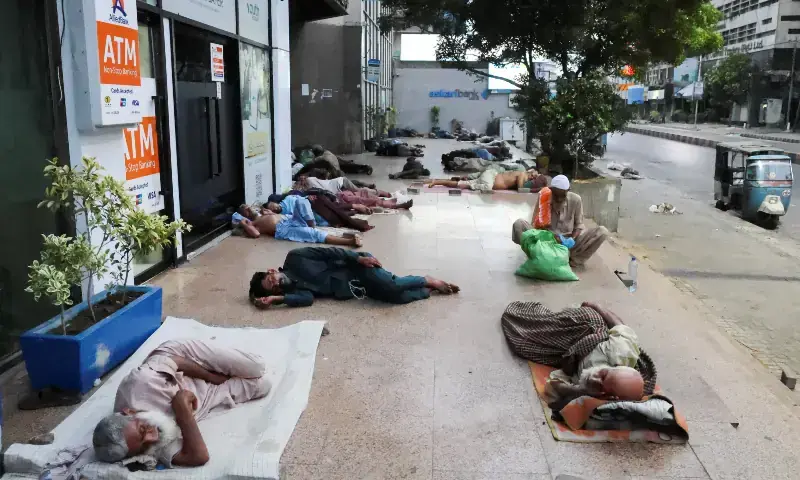
Worsening urban heat could trigger public health meltdown, expert warns
Why this matters: local context for readers following news across Pakistan and the region.
Responding to Dawn’s queries about Karachi’s challenges on the eve of World Environment Day, Prof Zafar Fatmi, Head of Environmental Occupational Health and Climate Change at the Department of Community Health Sciences, Aga Khan University, said that the city’s urban heat effect appears to be becoming more intense. “This is not only because of global climate change, but also because of how the city is growing, how people move through it, how much pollution they breathe, and how little protection many people have while working and living outdoors,” shared Prof Fatmi, who has done several studies on subjects related to community health. He explained that more concrete, more roads, high-density construction, traffic congestion, loss of trees, and fewer open spaces are making the city absorb and retain more heat. Referring to studies conducted from Karachi, he said that they showed that urban heat island effects are present, with higher night-time land surface temperatures in urban areas, and recent work has identified heatwave vulnerability in the city’s dense urban zones. “A 2026 multi-city Pakistan study also found that Karachi has the highest urban-rural temperature difference among major cities studied, around 4.5°C, and linked vegetation loss with higher land surface temperature. “This means Karachi is not only experiencing hotter weather; it is also being built in a way that makes heat worse. In our own microscale urban heat work in Kar