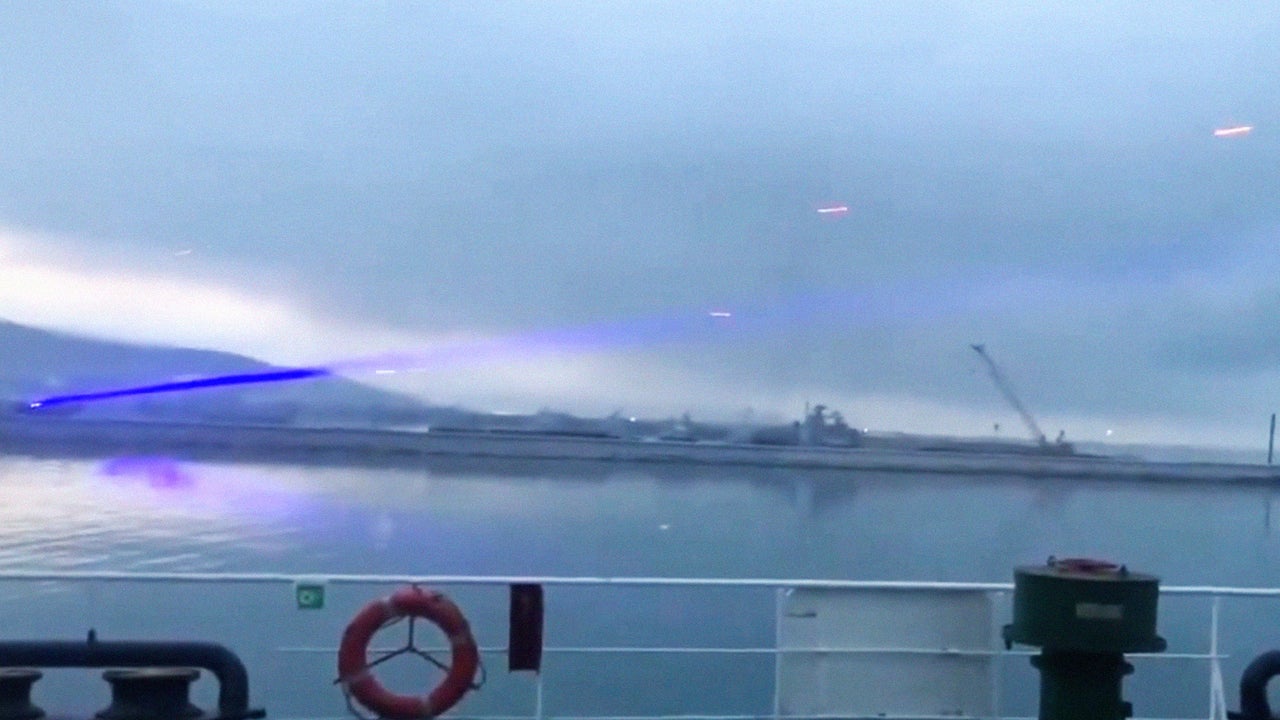
A Ukrainian drone attack reveals the limits of laser warfare
This article is republished with permission from Laser Wars, a newsletter about military laser weapons and other futuristic defense technology. The footage is 40 seconds long and, depending on your expectations, either mundane or extraordinary. Shot from the deck of a vessel in the harbor of the Russian port city of Novorossiysk on the night of May 22-23 and published to social media by conflict tracker Exilenova Plus on May 28, a Ukrainian attack drone flies low across the fog-shrouded Black Sea toward a Russian warship. The footage shows Russian forces move to intercept the incoming threat: the harbor lights shimmer in the water as tracer fire arcs through the overcast sky. Suddenly, vivid blue beams of light slice across the frame and sweep toward the incoming drone. Bright enough to reflect off the water’s surface, they look like something out of a science fiction movie. The drone hits its target anyway. The details of the remarkable attack are unclear. Ukraine’s Unmanned Systems Forces (USF) stated on May 23 that the strike, part of a broader assault on Novorossiysk that also targeted oil storage facilities, had damaged the Russian frigate Admiral Essen, but the military’s General Staff claimed the next day that the drone had actually struck the patrol ship Pytlivyi. What’s not in dispute is what the footage shows: Russian forces deployed low-power laser dazzlers against an incoming Ukrainian drone. And, more importantly, they didn’t work. Watch the full footage of the engagement from Exilenova Plus: An FP-1/2 drone struck the Project 11356 frigate Admiral Essen at the Novorossiysk naval base on May 23 pic.twitter.com/W41orgPELt— Exilenova+ (@Exilenova_plus) May 29, 2026 When the footage of the Novorossiysk assault went viral last week, an open-source intelligence analyst quickly identified the likely source of those vivid blue beams as a 445nm gallium nitride (GaN) laser, a commercially available, relatively inexpensive blue laser that was, in all likeli