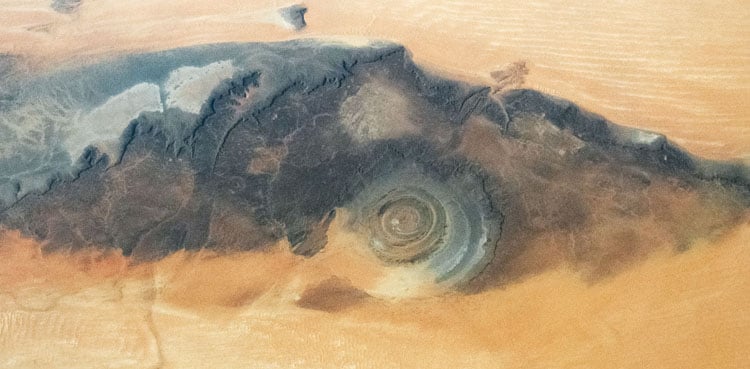
What lies behind the Eye of the Sahara formation? NASA explains
Key takeaways
- From orbit, the formation appears almost unreal, a near-perfect circular pattern stamped into the Sahara desert, something that for years led many to assume it was the result of a meteor impact.
- But the latest interpretation shared through NASA Earth Observatory leans firmly in another direction.
- The structure stretches roughly 25 miles across, though measurements can vary slightly depending on how the boundaries are drawn.
Why this matters: local context for readers following news across Pakistan and the region.
Observations by NASA from the International Space Station have once again drawn attention to one of the most striking natural formations in the Sahara desert—the massive Richat Structure, often called the “Eye of the Sahara.”
From orbit, the formation appears almost unreal, a near-perfect circular pattern stamped into the Sahara desert, something that for years led many to assume it was the result of a meteor impact.
But the latest interpretation shared through NASA Earth Observatory leans firmly in another direction. The so-called eye, it turns out, is the result of a geological uplift—essentially a dome of rock slowly exposed and carved out by erosion over time.