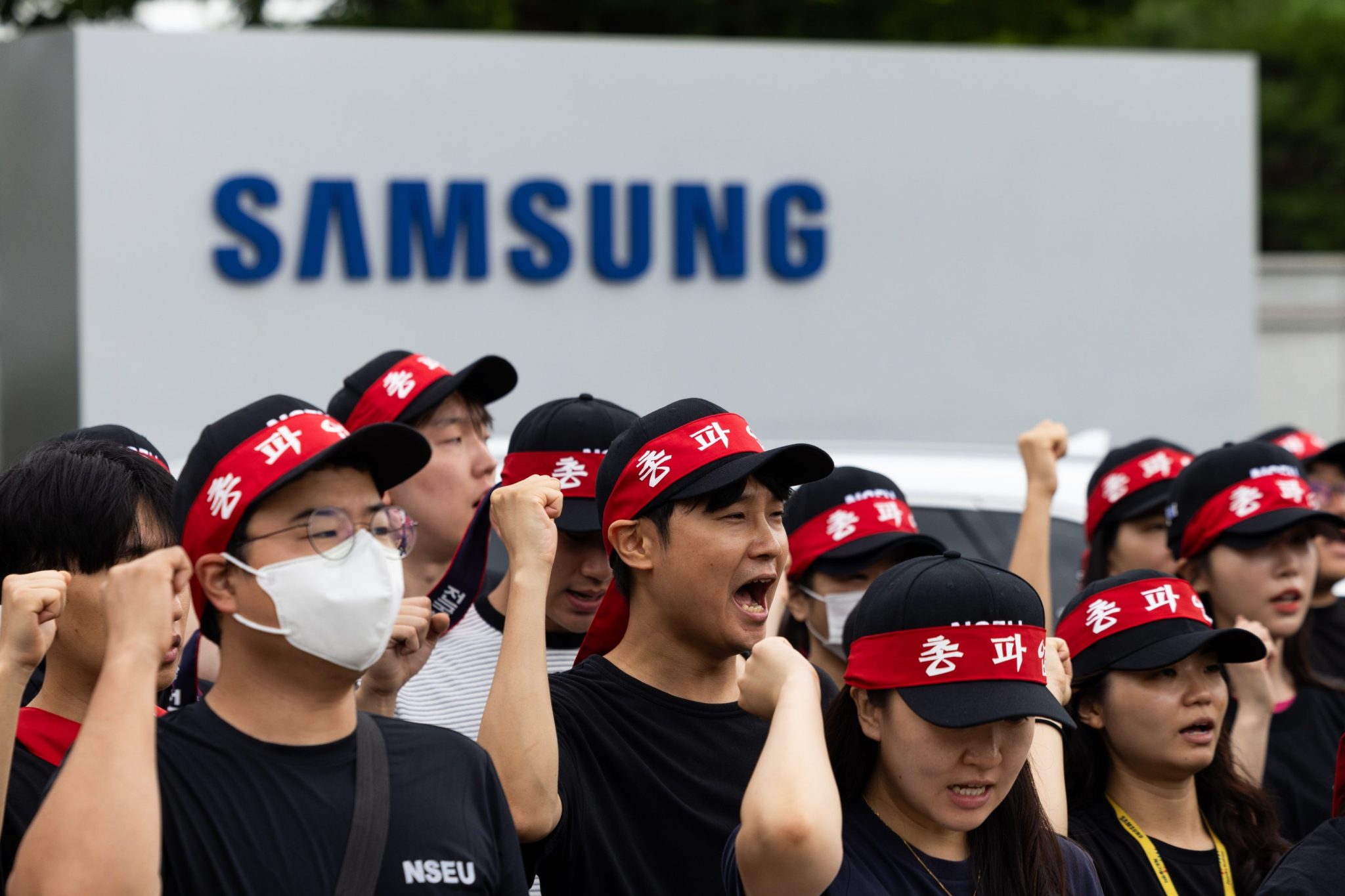
A 45,000-person labor strike at Samsung’s memory chip plants could throw a wrench into the AI boom
Samsung makes about a third of the world’s DRAM—the memory inside virtually every phone, laptop, server, and data center on the planet. Together with its Korean rival SK Hynix, it controls roughly two-thirds of the global DRAM market and an even larger share of high-bandwidth memory (HBM), the specialized chips that AI systems cannot run without. Samsung and SK Hynix are two of only three companies that make HBM at all; the third being American semiconductor company Micron. When people talk about AI infrastructure, they tend to focus on Nvidia’s GPUs. But those GPUs are useless without the memory chips stacked alongside them, and Samsung’s three fabrication complexes in South Korea are among the most important pieces of the AI industrial boom. Samsung operates 12 fabrication lines, employs over 260,000 people worldwide, and is investing $73 billion in semiconductor capex and R&D this year alone, the largest single-year chip investment by any company in history. That’s why it’ll be a shock to the system when on May 21, nearly 45,000 of Samsung’s unionized workers plan to walk off the job for 18 days. If that happens, it will be the largest work stoppage in the history of the semiconductor industry, at the single most important chokepoint in the AI supply chain. But unlike past labor disputes, AI hyperscalers won’t be able to absorb a supply disruption. The strike Last September, SK Hynix settled with its own union to allocate 10% of annual operating profit directly to employees as performance bonuses for the next decade, while removing caps on bonuses. Based on 2026 profit forecasts, that translates to average payouts of $460,000-$477,000 per worker this year across SK Hynix’s 35,000 staff, with projections approaching $900,000 per person next year. This is nothing new for SK Hynix: it already paid profit-sharing bonuses averaging about $95,000 per employee this past February. Now, Samsung’s unions are requesting