Q&A: What do China’s provincial five-year plans say about climate and energy?
Why this matters: environmental and climate reporting with long-term consequences.
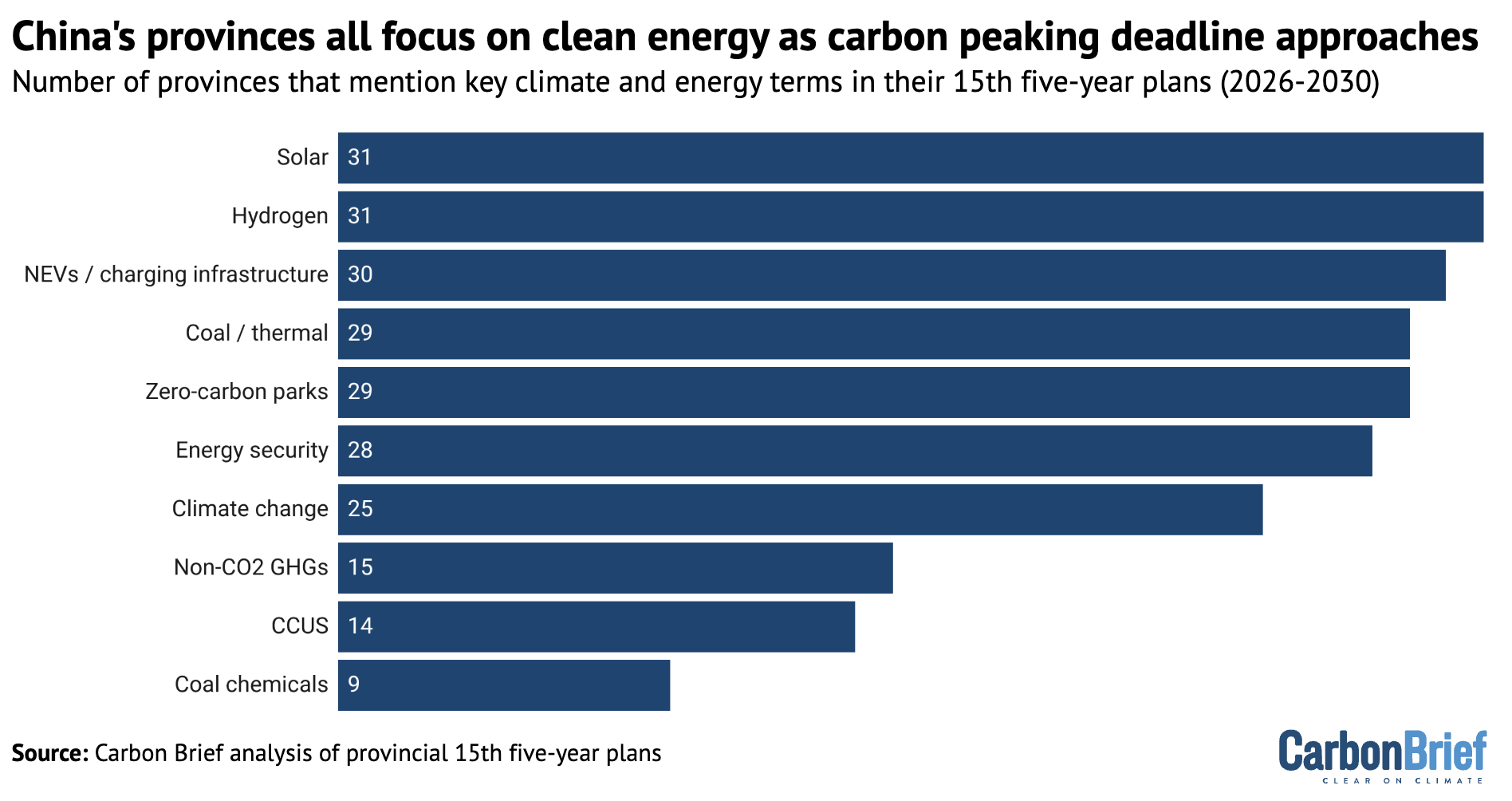
China’s provincial-level governments have now all published their 15th five-year plans – economic and social development blueprints for 2026-2030. These provincial plans reaffirm the overall trajectory of China’s energy transition, but reveal regional differences, based on economic and geographic considerations. Provincial plans are a critical mechanism for showing how high-level targets from the central government will be translated into action. For example, binding indicators set at national level include reductions in carbon intensity – carbon dioxide (CO2) emissions per unit of economic output – and the proportion of non-fossil energy in total consumption. Subsequent targets are then set for each province and tied to the performance evaluations of top local officials, who are ultimately responsible for delivery. Similarly, provincial plans also build on qualitative policy directives in the national-level plan, such as further developing new-energy vehicles (NEVs) and hydrogen industries. Specific policies, such as boosting production capacity, appear in several provincial-level plans. Below, Carbon Brief analyses what the 31 documents say about energy and climate. What do the provincial plans say about climate goals? At the broad level, the new provincial plans follow China’s overarching climate goals. All 31 provincial-level jurisdictions in mainland China have pledged to peak carbon emissions before 2030. Every plan also mentions the core elements of China’s energy transition strategy, including solar, wind, hydrogen, energy storage and upgrading the power grid. While solar features in every plan, specific interests in the technology vary from province to province. Some set goals to add new solar capacity by 2030. Zhejiang province aims to add 90GW of solar capacity, while Shaanxi plans to “accelerate” construction of wind and solar bases in the north of the province, as well as “solar+” models – such as “forest-solar” and “tea-solar” – in the south. Several p