Factcheck: What the UK car industry is not saying about EV targets
Why this matters: environmental and climate reporting with long-term consequences.
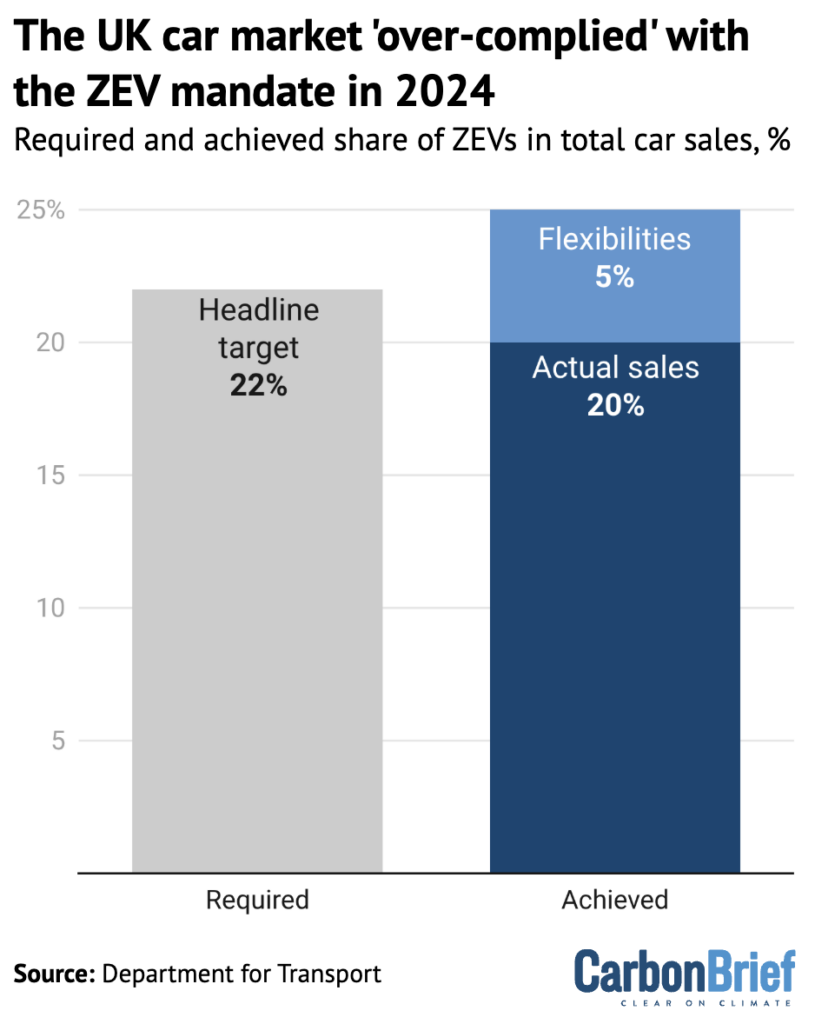
For several years, the UK car industry has been claiming that demand is not high enough to meet the government’s targets for sales of “zero emissions vehicles” (ZEVs). To date, however, the car industry has actually beaten the targets under the government’s “ZEV mandate”. This pattern of claiming demand is not high enough is being repeated in a regular cycle, following the publication of monthly statistics on new UK car sales by the Society of Motor Manufacturers and Traders (SMMT). Each month, this messaging is amplified by large sections of the media, which have published dozens of articles stating – incorrectly – that car companies are missing their ZEV targets. Meanwhile, the car industry is lobbying for an “urgent review” of the targets, on the basis that “natural demand is still well below the level demanded by the [ZEV] mandate”. UK car market has ‘over-complied’ with its targets In 2021, the UK’s then Conservative government developed the idea of a “ZEV mandate” as a way to drive sales of electric vehicles (EVs). The idea, inspired by a similar scheme in California, is to set a rising target for the share of new car and van sales that must be “zero-emissions vehicles” (ZEVs) each year. For cars, these targets started at 22% of sales 2024, increasing gradually each year to 80% by 2030. Towards the end of the first year of the scheme, in November 2024, the SMMT warned that the industry was “likely to fall short”, with EVs making up “just…18.7%” of sales. It said: “The industry looks likely to fall short of the 22% EV market share demanded, potentially creating a £1.8bn bill for compliance.” (If manufacturers fall short of their target, they can still avoid having to pay a “bill for compliance” by trading “credits” with other firms, or “borrowing” allowances from future years.) But, contrary to the industry messaging on the headline 22% goal, the car market actually “over-complied” in 2024, according to official figures published in early 2026. As such, a