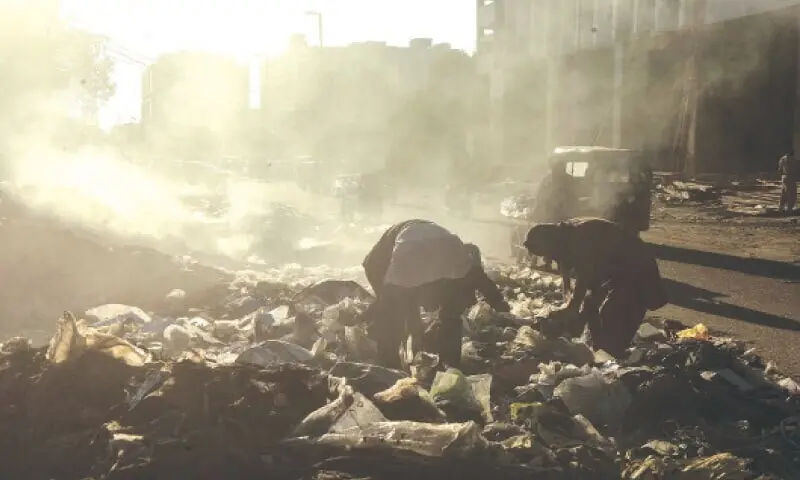
Breathing in Karachi comes with a warning as air quality deteriorates
Why this matters: local context for readers following news across Pakistan and the region.
KARACHI: Raising serious concern over the rapid environmental degradation the metropolis has experienced in recent years, speakers at a conference held on Tuesday at Karachi University (KU) said that the city’s air quality index has reached alarming levels, seriously threatening public health. They questioned the authorities’ silence as the city continues to lose its trees to development projects and housing schemes. The event — Climate Matters Conference — was organised at KU’s Chinese Teachers Memorial Auditorium by the Institute of Environmental Studies (IES). The event, themed “inspired by nature, for climate, for our future”, was held in connection with World Environment Day. Experts say city’s air quality index has far exceeded WHO limits In his remarks, IES Director Dr Farrakh Nawaz regretted that while Pakistan was among the countries most vulnerable to climate change, “societal awareness and seriousness were almost non-existent”. Describing environmental pollution and the rapidly changing climate as major national challenges, he called for urgent action to tackle the environmental issues threatening human survival. “Karachi’s air quality index has reached alarming levels, far exceeding WHO limits, posing grave public health risks,” he said. Highlighting Karachi’s waste management issues, he informed the audience that the city generated nearly 16,000 tonnes of solid waste daily, while 450-600 million gallons of untreated wastewater were discharged into the sea. “Without responsible waste management and environmental protection, no positive change can be expected,” he stressed. KU IES faculty member Dr Amir Alamgir noted that scientific studies had clearly established the global impacts of climate change. Unfortunately, however, action on the ground remained limited. “While we are seeing a lot of global and local research on these subjects, practical measures remain inadequate,” he said, while highlighting the contradiction between advocating environmental pr