AI welfare research needs basic science
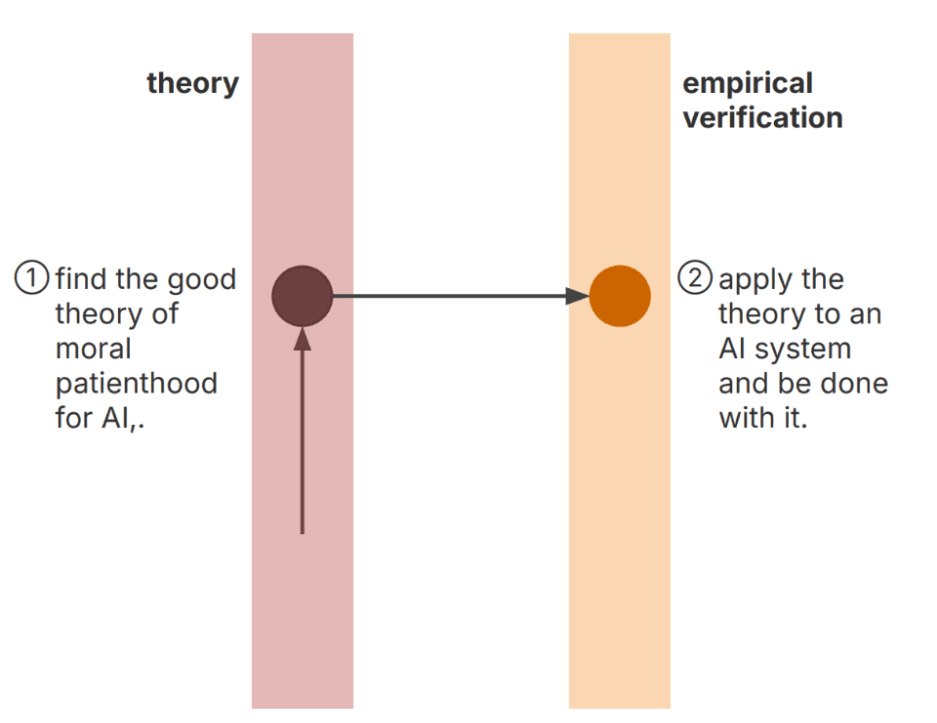
Over the course of MATS 9.0 we formed some views about AI welfare research that we thought were worth writing up. This post is meant to spark discussion rather than to present definitive conclusions. Thanks to Patrick Butlin for useful comments on a previous draft, and for many conversations over the course of MATS which influenced our views. Thanks also to Caspar Kaiser for comments.A prominent approach in AI welfare research is to start from a theory of moral patienthood, derive indicators from it, and attempt to apply it to AI systems to determine whether they satisfy the theory. We'll refer to this as the top-down theory-driven approach[1].We think this approach faces two problems:In practice, applying theories to AI systems requires making assumptions that are hard to justify, which limits the strength of conclusions.More broadly, we think current theories will fail to generalise to AI systems. They are calibrated to humans, and as a result end up either over-inclusive (assigning moral patienthood to entities that should not be included), under-inclusive (failing to assign moral patienthood to entities that should be included), or indeterminate (failing to provide a clear verdict about the moral patienthood of a system) .Instead of the top-down approach, we advocate for iterative, bottom-up basic science that is theory-informed (but not theory-driven). Crucially, this approach does not require presupposing a theory of moral patienthood.Even for those readers that remain attached to a theory of moral patienthood, we argue empirical findings should at least be used to adjudicate between competing theories. In fact, even readers committed to the top-down theory-driven approach should recognise that applying their chosen theory to AI requires resolving questions about AI systems through bottom-up empirical work.1. Issues with the top-down theory-driven approachBefore presenting its issues, it is worth outlining the two steps that top-down theory-driven approach typ