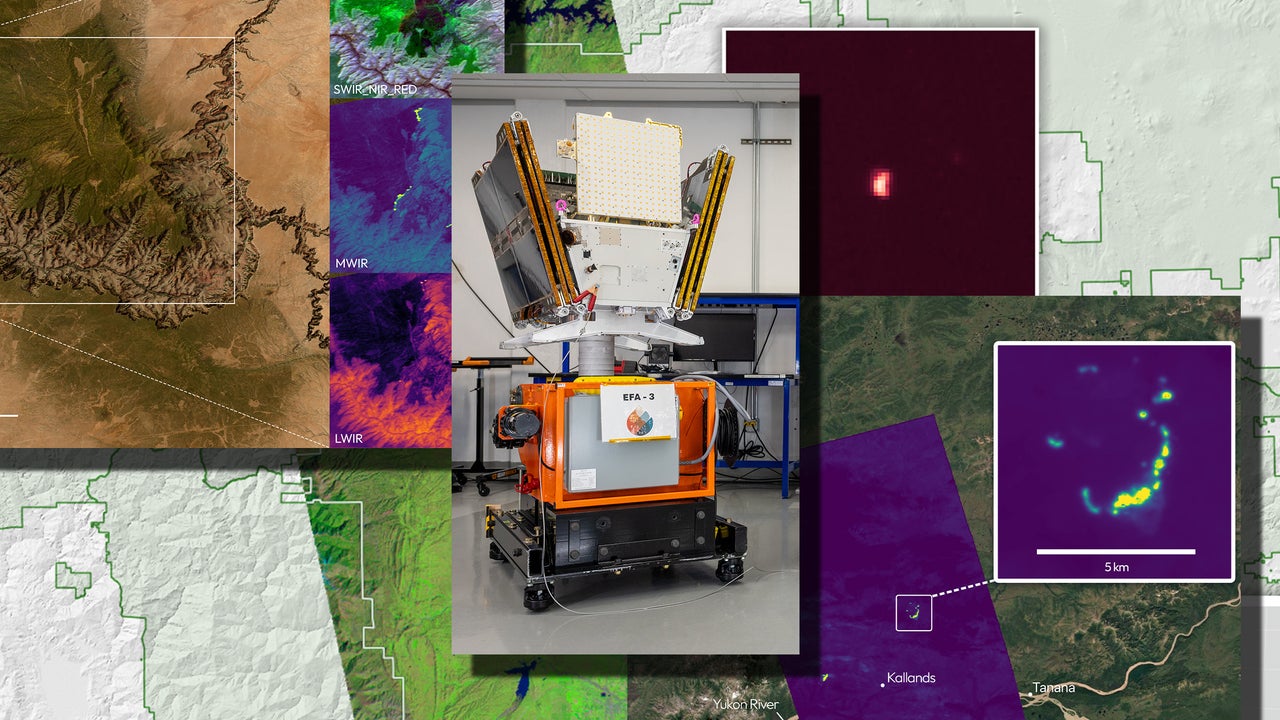
These new satellites are designed to spot wildfires before they spread
When a grass fire started by the side of an Oregon road last summer, it covered just half an acre—too small to show up on typical satellites. But it was spotted by a new prototype from Fire Sat, a satellite program designed specifically to detect wildfires. Fire agencies weren’t using the system at the time, but once fully operational, it could send alerts before fires spiral out of control. Now, with a $26 million grant from the Bezos Earth Fund that builds on earlier support from Google.org and other partners, three FireSat satellites will launch next month and begin tracking fires globally. By 2030, Earth Fire Alliance, the nonprofit behind the program, plans to have a constellation of 50 satellites in place, revisiting every point on the planet every 20 minutes. Medford, Oregon, June 23, 2025. [Image: Earth Fire Alliance and Muon Space] “We realized there was a big gap in the understanding of fire,” says Brian Collins, the nonprofit’s executive director. The organization, which launched in 2024, started after the team met with more than 200 fire agencies, land managers, and policymakers to better understand how to improve resilience to wildfires. “The biggest theme that kept coming up was better data to truly understand the scope and scale of wildfire across the planet,” he says. [Photo: Oregon Department of Forestry Southwest District] Weather satellites can already spot some fires, but they weren’t built for that purpose. FireSat’s satellites, designed by Muon Space, collect data across wavelengths beyond visible light, each revealing something different. Short-wave infrared can see through smoke. Mid-wave infrared can detect both intense fires and lower-intensity burns. Long-wave infrared measures ground temperature. Near infrared shows how plants and trees are responding to fire. From left: Paul Bodnar, Director of Sustainable Finance, Industry, and Diplomacy, Bezos Earth Fund; Brian Collins, Executive Director, Earth Fire Alliance; and Dr. Karen O’Connor, St