Two critiques of Rethink Priorities’ Moral Weights project
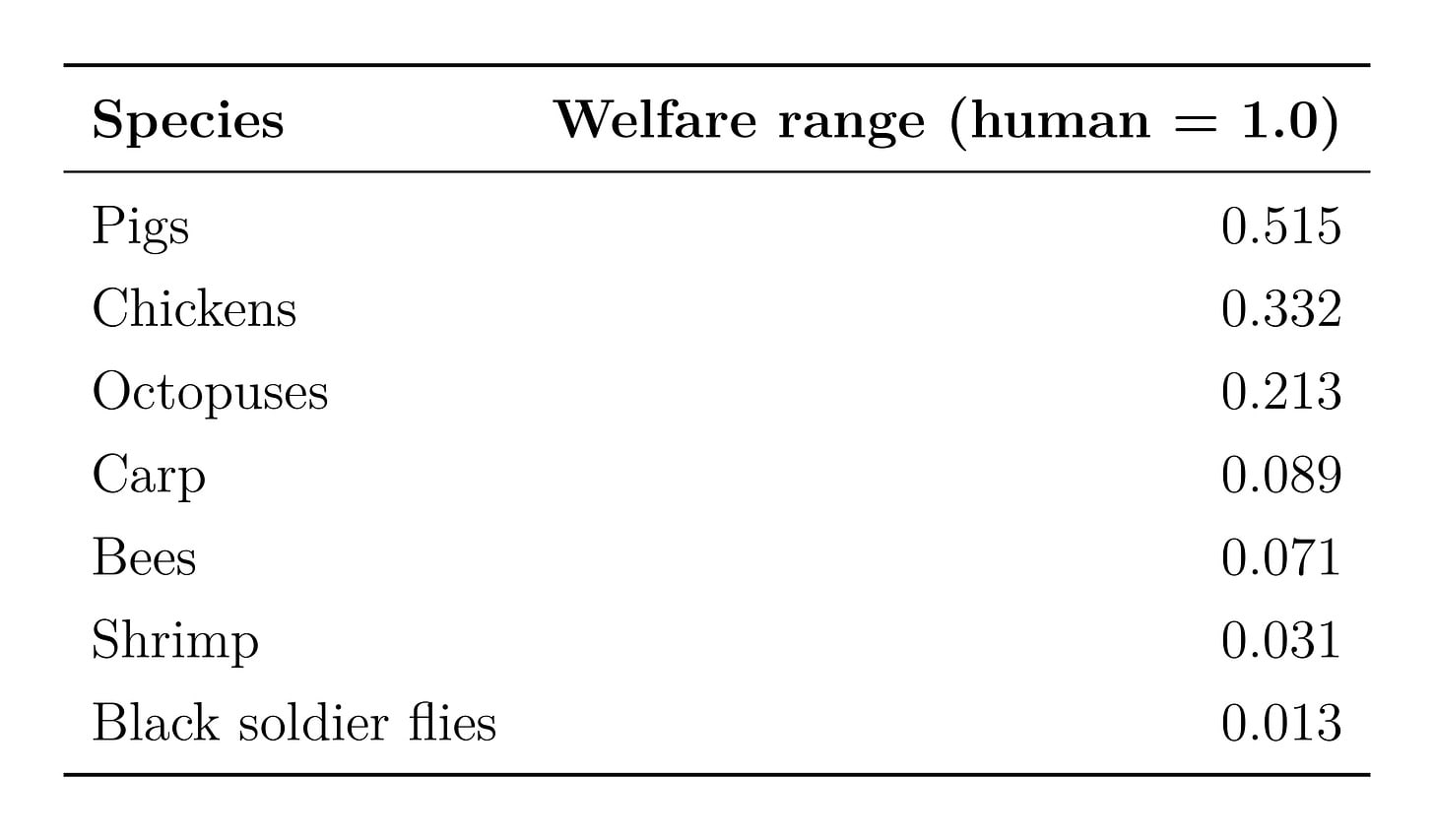
Roughly speaking, Rethink Priorities’ Moral Weight Project tries to estimate how intense suffering is in different animals, relative to humans. A moral weight of 1.0 means it is exactly as intense as in humans.It’s notoriously animal-friendly, e.g. it holds that 14 bees = 1 human. Here are some of the results:The calculation essentially uses a weighted factor model:Empirical proxies (60% weight): The animal is evaluated for presence/absence of a set of cognitive (e.g. object permanence, responses to novelty) and affective (e.g. depression-like behaviour, disgust-like behaviour). The contribution here is essentially the fraction of proxies that are present, where having 100% of them gives a moral weight of 1.0.Neurophysiological model (30% weight): Uses neuron counts and other neurophysiological data.Equality model (10% weight): Deliberately assumes equal welfare rangesThere is also a “probability of sentience” multiplier appliedIt is the “Empirical proxies” that substantively produce the animal-friendly results. “Probability of sentience” and “equality model” are essentially subjective researcher judgements baked into the model. “Neurophysiological model” does weight large animals highly and small animals low-ly, but because the model is additive any moderately small animal gets a weight of ~0, the effect of this is just to apply a ~30% discount to any small animal.This post covers two critiques of the “empirical proxies”, which push them to be overly animal friendly.1. Functional analogues: double countingThe whole logic behind using these empirical proxies is the idea of “functional analogues”: if a human shows “depression-like behaviour”, and a chicken shows “depression-like behaviour”, then these are analogous, and the chicken’s behaviour is evidence that it has something like the experience of depression. This is fair enough as far as it goes.The problem is that the model treats each proxy as independent evidence. A pig scores “Likely Yes” on anxiety-like behav