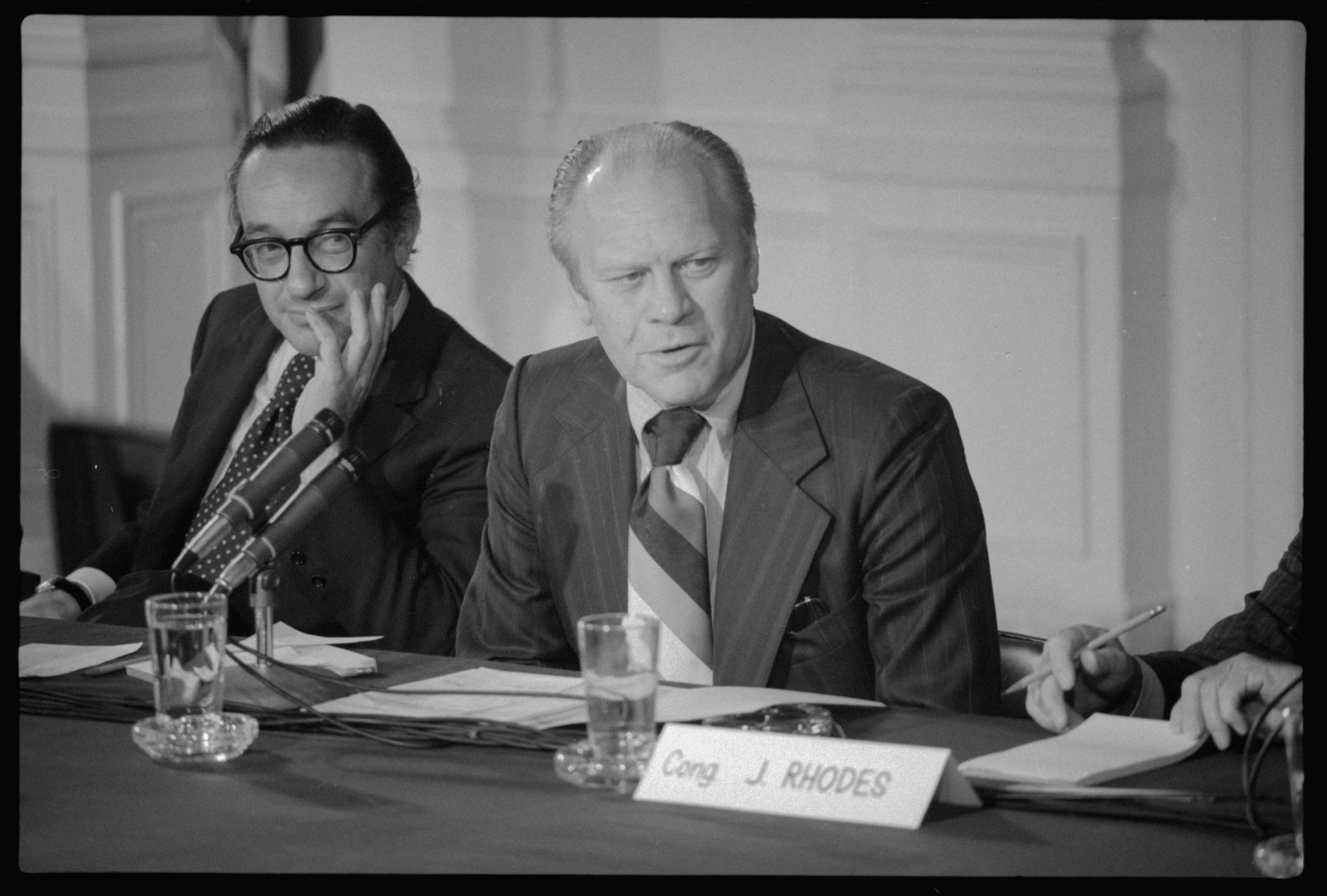
Alan Greenspan said 3 years with Gerald Ford beat 18 at the Fed. His death at 100 raises the question: was he right?
Alan Greenspan, who died on June 22, 2026, at the age of 100, is best remembered for his 18 years at the helm of the Federal Reserve. What many people don’t know is that an earlier and more obscure stint during the administration of President Gerald Ford shaped him as a public servant. As professors of economics, we haven’t just covered Greenspan’s legacy for our students. We also knew him personally, in different capacities: One of us interviewed him in 2016 for a book on public service, and the other was present as a young professor when Greenspan defended his dissertation at New York University in 1977. To us, one of the most notable aspects of his career was his commitment to public service, cemented while he served as chair of the Council of Economic Advisers from 1974-77, during the Ford administration. Greenspan is seen here in 1974, the year he started his term with the Council of Economic Advisers. AP Photo/Charles Kelly The early years The younger Greenspan cut a different figure. He studied clarinet at the Juilliard School and worked as a professional musician while attending New York University in the late 1940s. He was briefly married to Joan Mitchell, an art historian who introduced him to the libertarian writer Ayn Rand. Through the 1950s Greenspan was part of Rand’s inner circle – which emphasized radical individualism, self-interest and laissez-faire capitalism – while he developed the building blocks for an economics career. Greenspan later came under criticism for his early association with Rand. But we believe that his approach to economics was essentially practical and fact-based, not ideological. “You begin with a conceptual framework of cause and effect,” is how he put it in the book interview. “And then you observe reality, and try to anticipate what is going to happen in the future, even though you can never see beyond a certain horizon. “Data are a measure of what is going on in reality,” he continued. “If you want to endeavor to try