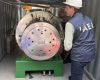
US removes 13.5 kilos of highly enriched uranium from Venezuela's RV-1 reactor
Key takeaways
- The material, enriched above the 20 percent threshold separating low-enriched from highly enriched uranium, had been considered surplus since the reactor ceased operations in 1991.
- The safe removal of all enriched uranium from Venezuela sends another signal to the world of a restored and renewed Venezuela, said NNSA Administrator Brandon Williams.
- Venezuela's transitional government, led by interim President Delcy Rodr guez, framed the operation differently.
Why this matters: an international story with cross-border implications worth tracking.
The U.S. Department of Energy's National Nuclear Security Administration (NNSA) has completed the removal of 13.5 kilograms of highly enriched uranium from the former RV-1 research reactor at the Venezuelan Institute for Scientific Research (IVIC), in Miranda state, in an operation coordinated with the United Kingdom, the International Atomic Energy Agency (IAEA), and Venezuela's transitional government.
The material, enriched above the 20 percent threshold separating low-enriched from highly enriched uranium, had been considered surplus since the reactor ceased operations in 1991. The extraction took place between 18 and 29 April. The uranium was packaged into a spent-fuel cask, escorted overland for some 160 kilometers to the docks at Puerto Cabello, and transported aboard a specialized vessel operated by the British firm Nuclear Transport Solutions to the Savannah River Site in South Carolina, where it will be processed into high-assay low-enriched uranium (HALEU).
The safe removal of all enriched uranium from Venezuela sends another signal to the world of a restored and renewed Venezuela, said NNSA Administrator Brandon Williams. He credited President Trump's decisive leadership for the speed of an operation the agency said would normally have taken years. The mission falls within the three-phase plan that the Trump administration and Secretary of State Marco Rubio designed for Venezuela following the capture of Nicol s Maduro in January. Energy Secretary Chris Wright visited Caracas in February to lay the groundwork.