New Instrument Used Antarctic Ice Sheet to Probe Extreme Universe
Why this matters: new research or scientific developments with potential real-world impact.
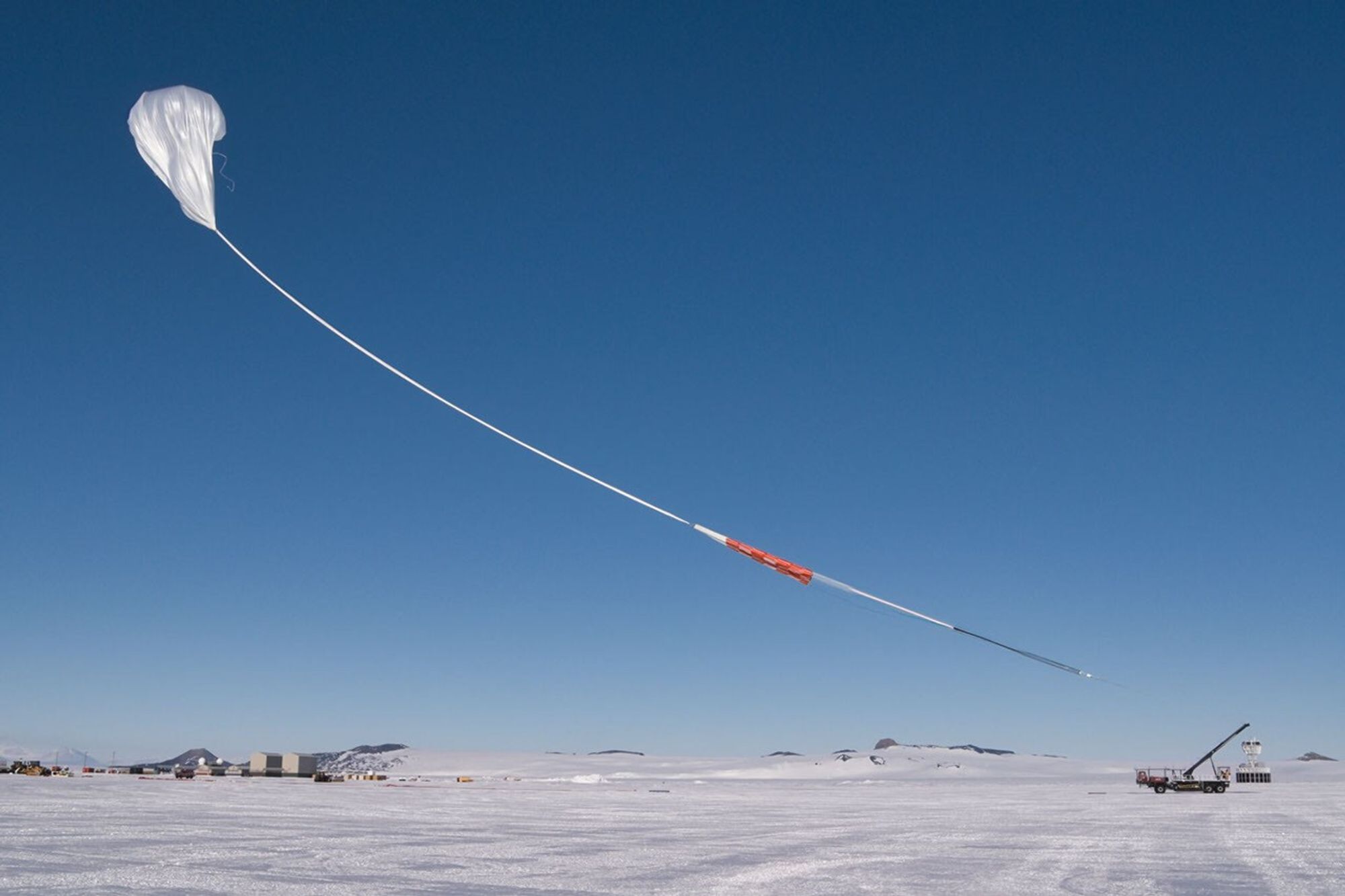
This image shows PUEO at the Long Duration Balloon Facility in Antarctica, immediately after balloon release. Credit: NASA/Scott Battaion The Payload for Ultrahigh Energy Observations (PUEO) is a NASA Astrophysics Pioneers Program mission designed to detect the most energetic particles in the universe. The PUEO mission flew high above Antarctica on a Long Duration Balloon (LDB) and used the Antarctic ice sheet as an enormous detection volume to look for radio signals generated by the interactions of extremely energetic astrophysical neutrinos as they passed through the ice. In addition to searching for the highest energy neutrinos, PUEO could also detect radio signals from high energy cosmic rays showering in Earth’s atmosphere (a.k.a. air showers), either as the signals entered directly into the instrument or reflected off the ice below. The sensitivity achieved with the PUEO instrument was a result of technology advancements and careful optimization of the experimental design to enable accommodation within the balloon platform’s launch volume. The ultra-high energy neutrinos that PUEO was searching for carry information from the most extreme places in the universe, including supermassive black holes that accrete matter at the centers of galaxies, neutron star mergers, and other powerful cosmic accelerators. Because these particles travel large distances along straight lines without being absorbed, they provide a unique view of the distant, most energetic universe. Not only will data collected by PUEO reveal the origin and composition of the highest-energy cosmic rays, it will also test fundamental physics at energies far beyond those achievable in human-made particle accelerators on Earth. The PUEO mission built on heritage from the NASA-sponsored Antarctic Impulsive Transient Antenna (ANITA) mission, which had four successful flights from 2006-2016. Like ANITA, PUEO consisted of an array of radio-frequency antennas, an onboard data acquisition system that is trig