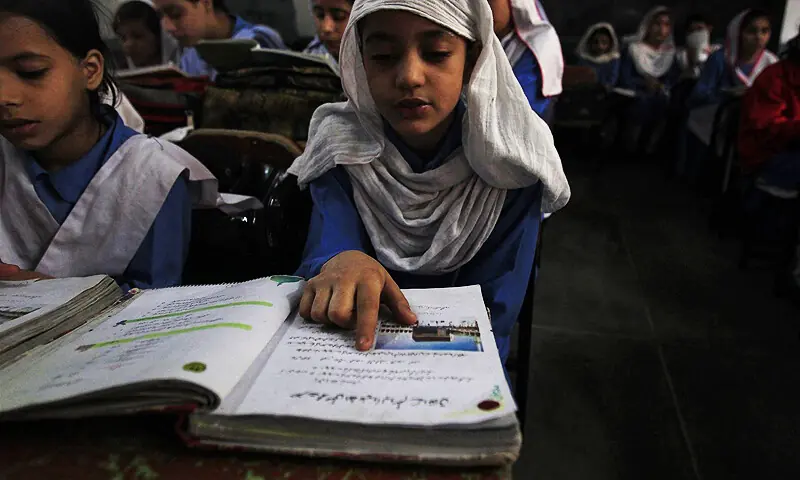
Literacy rate improves by 2pc, but education spending falls in 2025
Why this matters: local context for readers following news across Pakistan and the region.
ISLAMABAD: The literacy rate for individuals aged 10 and above in Pakistan rose from 61 to 63 per cent, while spending on education faced a decline, according to Economic Survey 2025-26. It stated that male literacy was 73pc and female at 54pc, reflecting a gradual progress and narrowing gender gap. Urban areas continued to have higher literacy rates with a total of 74 per cent (81 per cent for males and 68 per cent for females), while rural areas had a lower rate of 55 per cent (67 per cent for males and 44 per cent for females). Rural female literacy showed the most significant improvement. Punjab recorded the highest literacy rate at 68 per cent, followed by Sindh and Khyber Pakhtunkhwa, both at 58 per cent. Balochistan had the lowest rate at 49 per cent. The urban–rural divide persisted with urban Punjab at 78 per cent and rural Sindh at 39 per cent. Overall, the data highlighted steady but uneven progress with rural female literacy playing a key role in the observed improvements, despite continuing regional and gender disparities. Expenditure The survey stated that education expenditure stood at Rs962 billion during the financial year 2025 compared to Rs1251.06 billion in the previous year. Expenditure in year 2024-25 remained 0.8pc of GDP while in year 2022-23 it was recorded at 1.5pc of GDP. In 2021-22, it was 1.7pc of GDP, showing a constant decline. In the year 2020-21, education expenditure was recorded at 1.4pc of GDP, while it was 1.9pc of GDP in 2019-20. Meanwhile, the survey highlighted the issue of out-of-school children (OOSC), stating that OOSC in Pakistan had declined from 38 per cent in 2023 (male: 35 per cent, female: 42 per cent) to 28 per cent in 2025 (male: 25 per cent, female: 31 per cent), demonstrating significant progress across all provinces particularly in Balochistan where the proportion decreased from 69 per cent to 45 per cent, followed by Sindh (47 per cent to 39 per cent), Punjab (32 per cent to 21 per cent), and Khyber Pakhtunkhwa