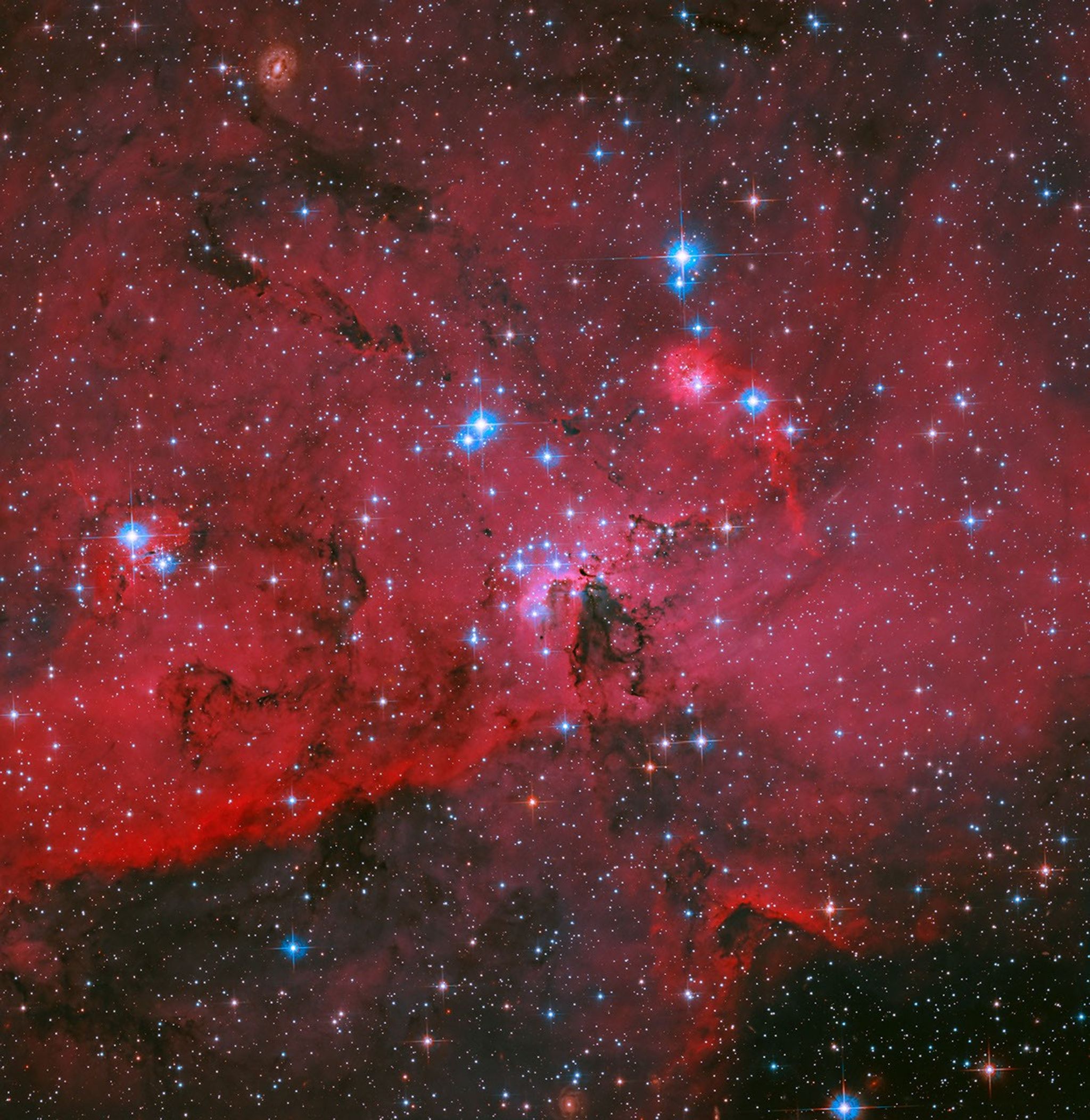
NASA’s Hubble Captures Crimson Cloud Sparkling with White, Blue Stars
Why this matters: new research or scientific developments with potential real-world impact.
Explore Hubble Hubble Home Overview About Hubble The History of Hubble Hubble Timeline Why Have a Telescope in Space? Hubble by the Numbers At the Museum FAQs Impact & Benefits Hubble’s Impact & Benefits Science Impacts Cultural Impact Technology Benefits Impact on Human Spaceflight Astro Community Impacts Science Hubble Science Science Themes Science Highlights Science Behind Discoveries Universe Uncovered Hubble’s Partners in Science Hubble & Citizen Science AI & Hubble Science Explore the Night Sky Observatory Hubble Observatory Hubble Design Mission Operations Science Operations Astronaut Missions to Hubble Hubble vs Webb Team Hubble Team Career Aspirations Hubble Astronauts Multimedia Images Videos Online Activities e-Books Sonifications Podcasts 3D Hubble Models Lithographs Fact Sheets Posters Hubble on the NASA App Glossary News Hubble News Social Media Media Resources 35th Anniversary More Online Activities 3 min read NASA’s Hubble Captures Crimson Cloud Sparkling with White, Blue Stars A glowing landscape of gas and dust revealed by NASA’s Hubble Space Telescope is heated and illuminated by a thriving population of young stars in the LH 95 region of the Large Magellanic Cloud. NASA, ESA, and N. Da Rio (The University of Virginia), G. De Marchi (European Space Agency – ESTEC), and D. Gouliermis (Universitat Heidelberg); Processing: Gladys Kober (NASA/Catholic University of America) Like fresh fireworks launched against a background of dissipating smoke, blue and white stars shine brilliantly against a crimson background of glowing gas in this image of stellar nursery LH 95 from NASA’s Hubble Space Telescope. LH 95 is a region in the Large Magellanic Cloud, a dwarf galaxy that orbits the Milky Way. Low-mass infant stars live alongside massive blue giant stars in what is known as a stellar association, one of many in the Large Magellanic Cloud. The LH 95 region’s most massive stars, possessing at least three times the mass of the Sun and vi