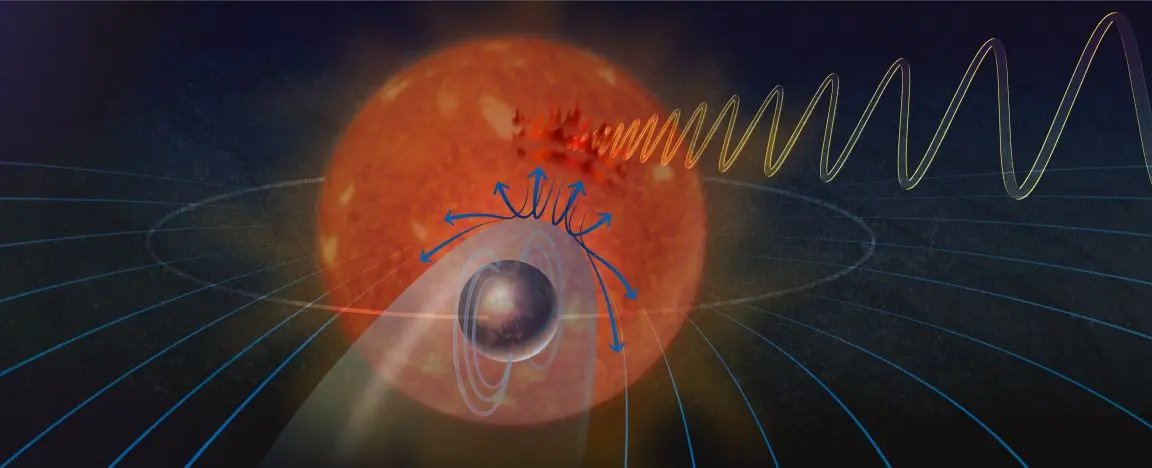
Planet orbits so close to its star that their magnetic fields connect
For most of human history, our view of "close to the Sun" was defined by the orbit of Mercury, with its 88-day orbit and barren, baking surface. But from the moment we started discovering exoplanets, it became very clear that our own Solar System was anything but a guide to the rest of the galaxy. Planets with orbits only a few days long are strikingly common, with the proximity to the star creating things that seem bizarre from our perspective: metal vapor in the atmosphere, or atmospheres puffed out to ridiculously low densities. Now, we can apparently add an additional oddity: overlapping magnetic fields. Researchers have found a star/planet combo that experiences periodic brightening, which they ascribe to the interactions between the magnetic fields of both bodies. Looking for repetition This is one of those cases where theory came before discovery. People had already proposed that a planet orbiting close to its host star could interact with it if its magnetic field were sufficiently strong. And, in a number of cases, researchers have found evidence that this is happening, with one case of an extremely young star emitting flares seemingly in response to the orbit of its innermost planet.Read full article Comments