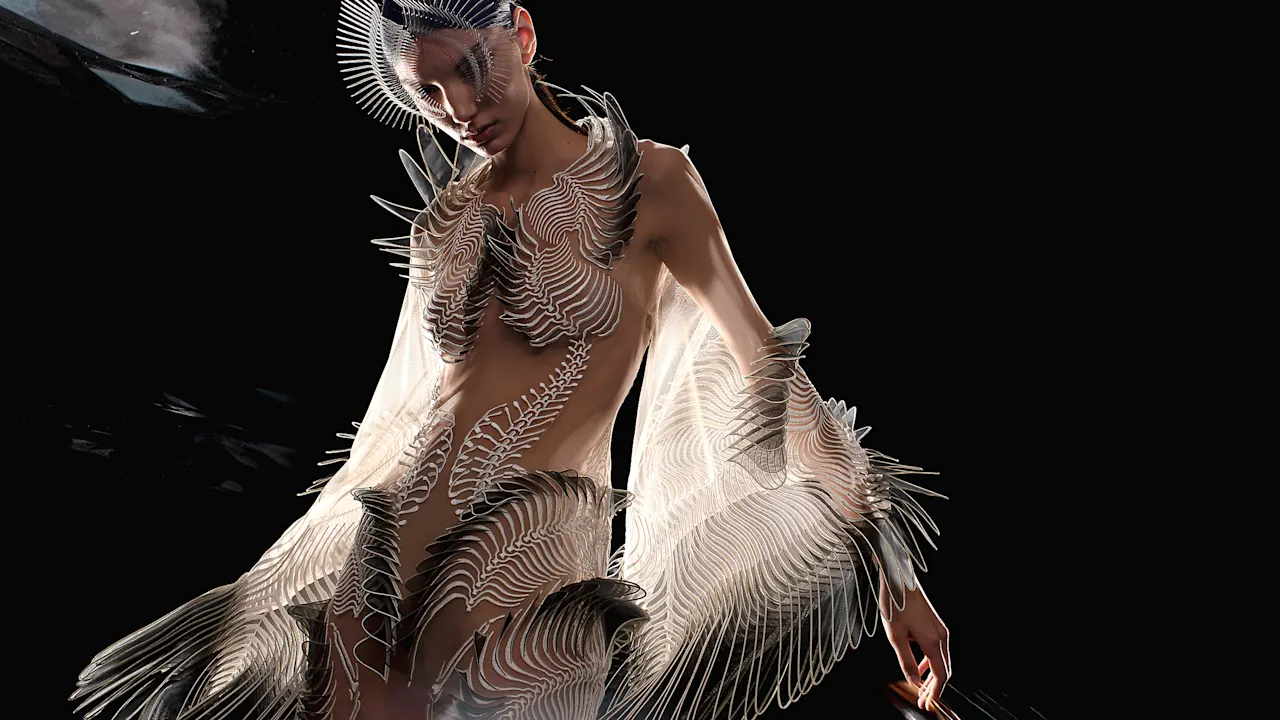
See the wild, beautiful, and almost unbelievable fashion of Iris van Herpen
When Olympic skier Eileen Gu walked the steps of the Metropolitan Museum of Art at the Met Gala on May 4, she wore a short, shimmering gown that appeared to be made of thousands of iridescent soap bubbles caught mid-float, clustered across her body and trailing into the air behind her. Eileen Gu at the Met Gala, 2026 [Photo: Getty] It was created by Iris van Herpen in collaboration with the Tokyo-London design studio A.A.Murakami. Assembled from 15,000 hand-formed glass bubbles, it took 2,550 hours to construct, and contained hidden microprocessors that released real bubbles into the air as Gu moved. It was also a glimpse into the show that opens at the Brooklyn Museum on May 16: Iris van Herpen: Sculpting the Senses, the North American debut of a retrospective that has already traveled from Paris to Brisbane, Australia, then Singapore and the Netherlands. The 2016 original of that bubble dress will be in the show. “It represents the air that’s inside of our bodies,” says Matthew Yokobosky, the Brooklyn Museum’s senior curator of fashion and material culture. “Over 90% of our bodies are made up of air.” Over two decades, van Herpen has built a body of work that treats science as a creative collaborator. She has made couture inspired by the air in our lungs, the architecture of a stingray’s skeleton, the magnetic fields of the Large Hadron Collider. She has worked with architects, paleontologists, and biologists, and used everything from iron filings to magnets to bioluminescent algae as raw materials. In doing so, she has quietly redefined what it means for fashion to be art. The Brooklyn Museum has been making that argument for nearly a century. Its 1934 Story of Silk exhibition is often cited as the beginning of fashion’s museum era; it has since staged retrospectives of work by Madame Grès, Schiaparelli, Jean Paul Gaultier, Pierre Cardin, Christian Dior, Virgil Abloh, and Thierry Mugler. Sculpting the Senses extends