What’s Up: June 2026 Skywatching Tips from NASA
Why this matters: new research or scientific developments with potential real-world impact.
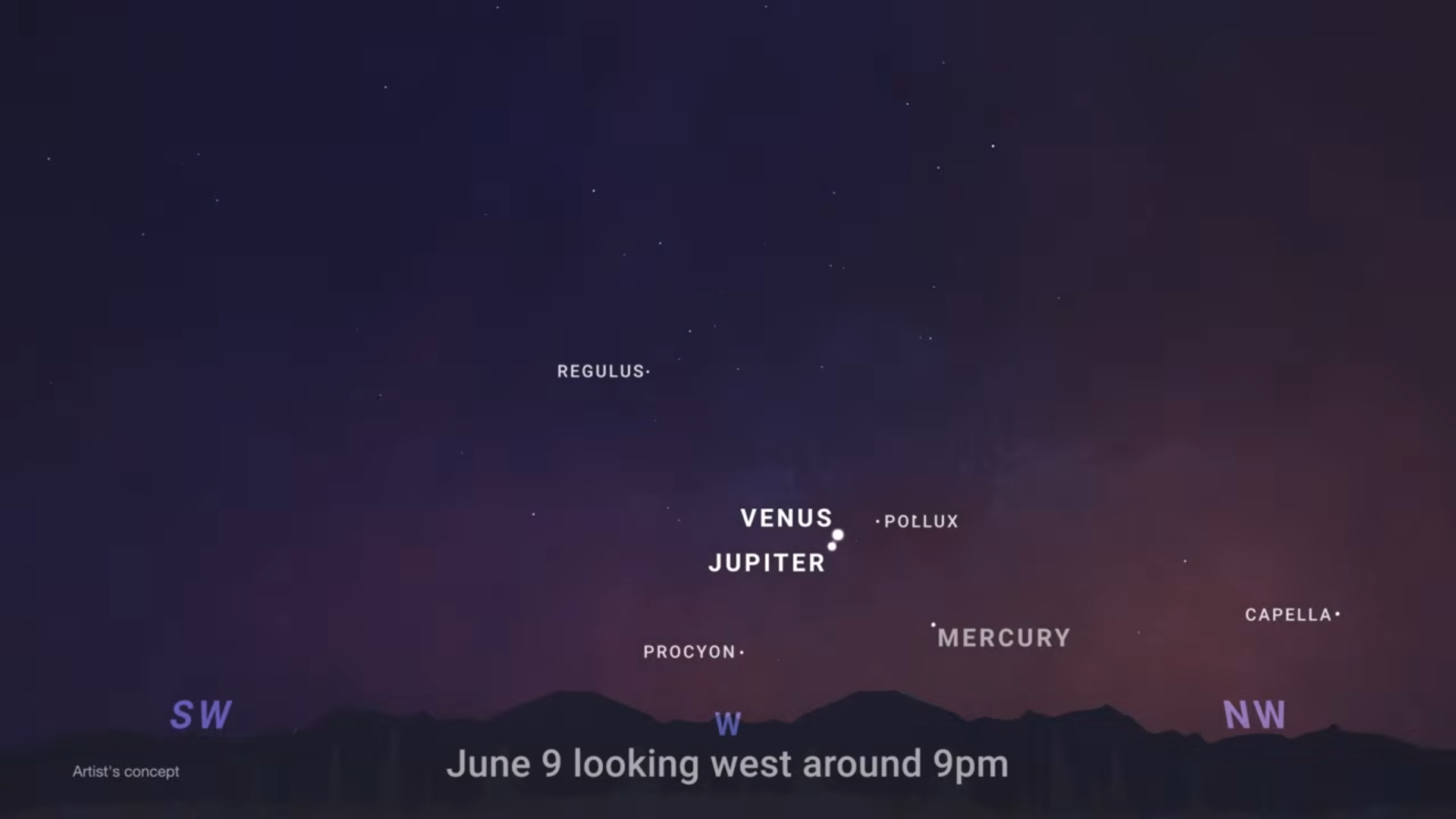
Skywatching Skywatching Home What’s Up Meteor Showers Eclipses Daily Moon Guide More Tips & Guides Skywatching FAQ Night Sky Network Venus and Jupiter meet after sunset, the Moon passes in front of Venus, summer begins, and deep-sky treasures rise into view. Skywatching Highlights June 9: Venus and Jupiter conjunction June 11–15: Mercury joins Venus and Jupiter after sunset June 17: Moon passes in front of Venus & close Moon and Venus pairing June 21: June solstice & start of astronomical summer June: Summer Triangle and deep-sky observing targets rise into view Transcript Planets gather after sunset, the Moon passes in front of Venus, summer officially begins and deep sky treasures rise into view. That’s What’s Up for June. Early this month, look west shortly after sunset to see Venus and Jupiter. They are two of the brightest planets in our sky and around June 9th, they’ll appear close together after sunset. This is called a planetary conjunction—when two planets appear near each other from our point of view on Earth, even though they’re still millions of miles apart in space. NASA/JPL-Caltech From June 11th through June 15th, Mercury joins the scene, creating a mini parade of planets low in the western sky. This happens because the planets orbit the sun along nearly the same path in our sky, called the ecliptic. So from our point of view on Earth, they sometimes appear to gather in the same part of the sky. NASA/JPL-Caltech Venus will be the brightest and easiest to spot with Jupiter nearby. Mercury will sit lower toward the horizon, so you will need a clear view to the west to catch it in the glow of twilight. On June 17th, from some locations the Moon will pass in front of Venus. This is called a lunar occultation. For viewers in the right viewing path, Venus will look like it disappears behind the Moon, then reappears later. The event will be visible from parts of the United States, Canada, Brazil and Venezuela. Outside of the exact viewing path