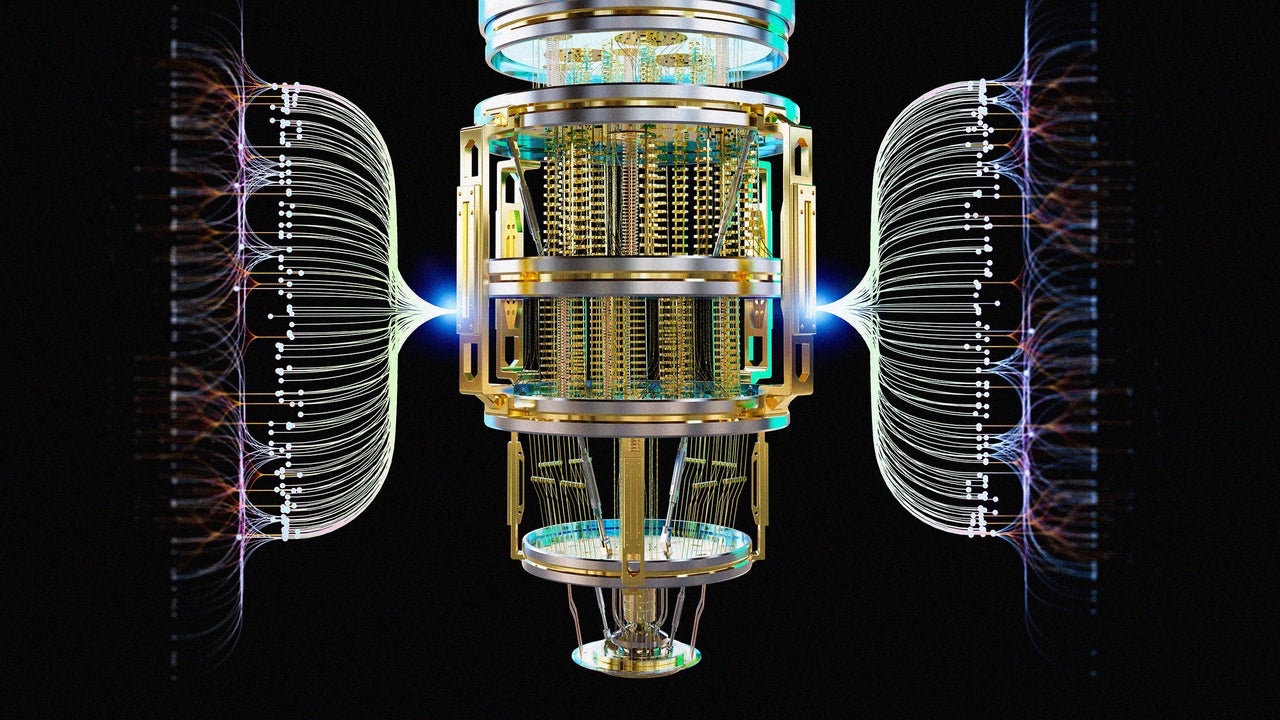
Quantum computing is about to get a lot more real
Just as AI has its dreams of “AGI” and “superintelligence,” quantum computing has its own north star: broad, practical quantum advantage over traditional supercomputers. The quantum industry’s goal is to build a large-scale, fault-tolerant quantum computer powerful enough to solve hard, economically valuable problems in fields such as chemistry, materials science, and drug discovery. Recent progress suggests the technology may be moving closer to that point. The question is whether quantum computers can finally emerge from the lab and demonstrate superiority over conventional machines in practical applications that matter. Why qubits are so hard to scale Conventional computers store information as bits, represented as either 0 or 1. Quantum computers use qubits, tiny physical systems that behave according to the strange rules of quantum mechanics. Qubits can exist in multiple states at once, allowing them to represent more complex mathematical information than zeros and ones alone. Through entanglement, the state of one qubit can also be linked to the state of another, allowing quantum systems to encode even more complex relationships. That promise comes with a major engineering problem. Qubits are highly sensitive to their environment, making it difficult to keep them in a coherent state long enough to perform useful computations. Many quantum systems keep qubits at temperatures just above absolute zero (minus 273.15 degrees Celsius, or minus 459.67 Fahrenheit) to slow their movement and reduce interference from environmental noise. Some quantum developers, including Google, have focused on systems that use additional qubits for error correction. Researchers believe quantum error correction is possible, but building systems that can detect and correct errors in real time, while scaling to many more qubits, remains one of the field’s central challenges. Solving that problem could make quantum machines accurate and powerful enough for commercially important work. Mon