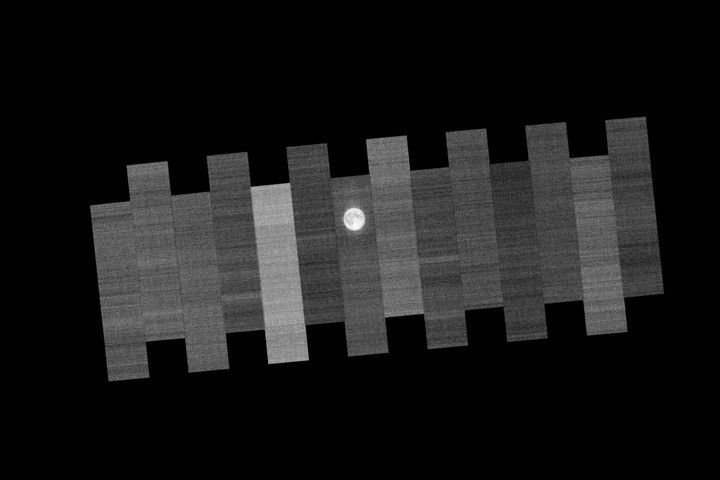
A Full Moon Checkup
Why this matters: new research or scientific developments with potential real-world impact.
Earth Observatory Science Earth Observatory A Full Moon Checkup Earth Earth Observatory Image of the Day EO Explorer Topics All Topics Atmosphere Land Heat & Radiation Life on Earth Human Dimensions Natural Events Oceans Remote Sensing Technology Snow & Ice Water More Content Collections Global Maps World of Change Articles Notes from the Field Blog Earth Matters Blog Blue Marble: Next Generation EO Kids Mission: Biomes About About Us Subscribe 🛜 RSS Contact Us Search To view this video please enable JavaScript, and consider upgrading to a web browser that supports HTML5 video The Moon appears along the centerline of scans acquired by the OLI (Operational Land Imager) on Landsat 9 on January 3, 2026. These monthly lunar scans help ensure the long-term consistency of Landsat’s Earth observations. Landsat Project Science Support/Ross Walter In April 2026, NASA’s Artemis program took humanity back to the Moon, providing a new look at Earth’s only natural satellite. As the world celebrates the return of Artemis II’s four astronauts, the lunar surface continues to play a critical role in missions much closer to Earth. Since 1972, the NASA/USGS Landsat program has captured the longest continuous record of Earth’s land surface, collecting images that track everything from crop health to glacial change. But with such a long data record, how can scientists trust that images acquired today can be accurately compared to those from days, years, or even decades ago? They look to the Moon. Unlike Earth, with its constantly changing weather, seasons, and landscape, the Moon is remarkably stable. With no atmosphere and virtually no surface changes, the Moon reflects sunlight in a predictable, consistent way. This stability gives engineers a reference to fine-tune Landsat’s instruments and be confident that the data are accurate. Once a month, during the full Moon, the spacecraft turns its instruments away from Earth and points them directly at the lunar surface. Over the