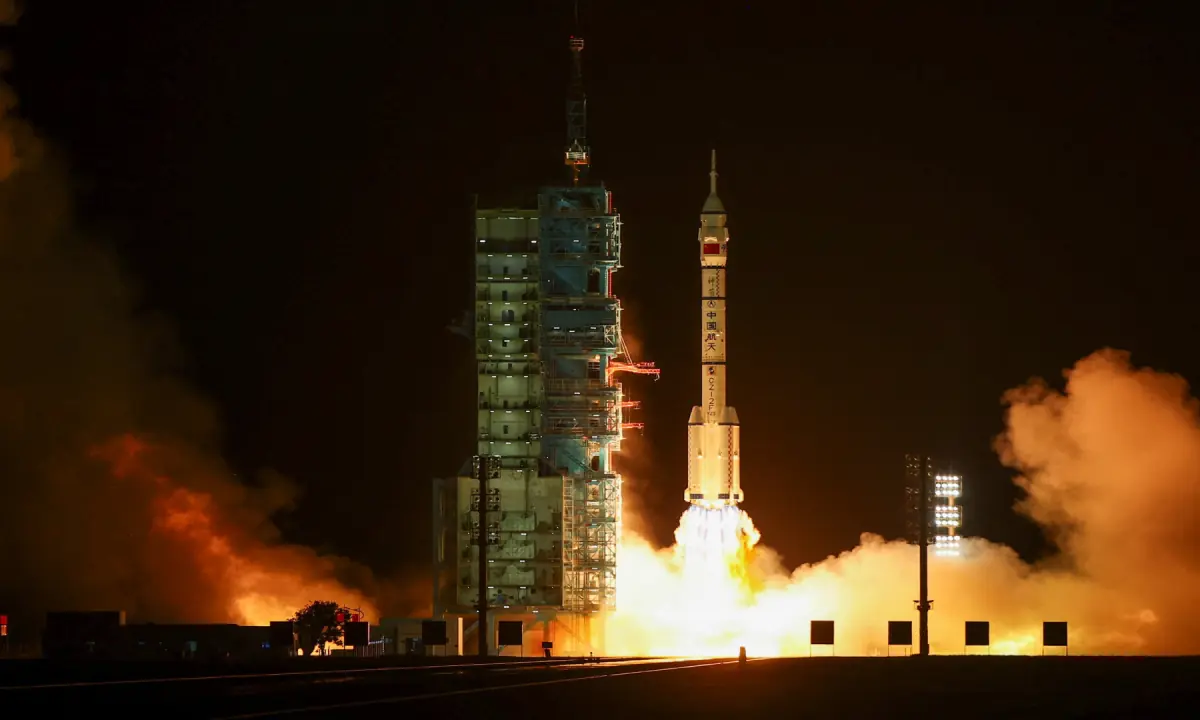
China launches three-crew space flight as part of Moon ambitions
Why this matters: local context for readers following news across Pakistan and the region.
China launched its Shenzhou-23 mission on Sunday, which will see a Chinese astronaut spend a full year in orbit for the first time, a crucial step in Beijing’s ambition to send humans to the Moon by 2030. The Long March 2-F rocket blasted off in a cloud of flames and smoke on time at 11:08pm (local time) from the Jiuquan launch centre in China’s northwestern Gobi Desert, video from state broadcaster CCTV showed. The spacecraft separated from the rocket around 10 minutes later and entered orbit, the Chinese space agency (CMSA) said on social media. “The astronauts are in good condition, and the launch has been a complete success,” it added. The mission marks the first spaceflight ever undertaken by an astronaut from Hong Kong: 43-year-old Li Jiaying (Lai Ka-ying in Cantonese), who previously worked for the Hong Kong police. Other crew members include 39-year-old space engineer Zhu Yangzhu and 39-year-old Zhang Zhiyuan, a former air force pilot, who is travelling into space for the first time. Cheering crowds waved Chinese flags at a farewell ceremony ahead of the launch, while a band played and the three astronauts saluted on stage. The crew is set to carry out numerous scientific projects in life sciences, materials science, fluid physics and medicine. A key experiment of Shenzhou-23 will be the full-year stay in orbit by one of the crew in order to study the effects of a long stay in microgravity. Year-long experiment The experiment is part of China’s preparations for future lunar missions, as well as missions to Mars. The astronaut selected for this one-year mission will be named at a later date, depending on the progress of the Shenzhou-23 mission, a spokesperson for the CMSA said on Saturday. The main challenges will be long-term effects on humans, including bone density loss, muscle wasting, radiation exposure, sleep disturbances, behavioural and psychological fatigue, said Richard de Grijs, an astrophysicist and professor at Macquarie University in Australia.