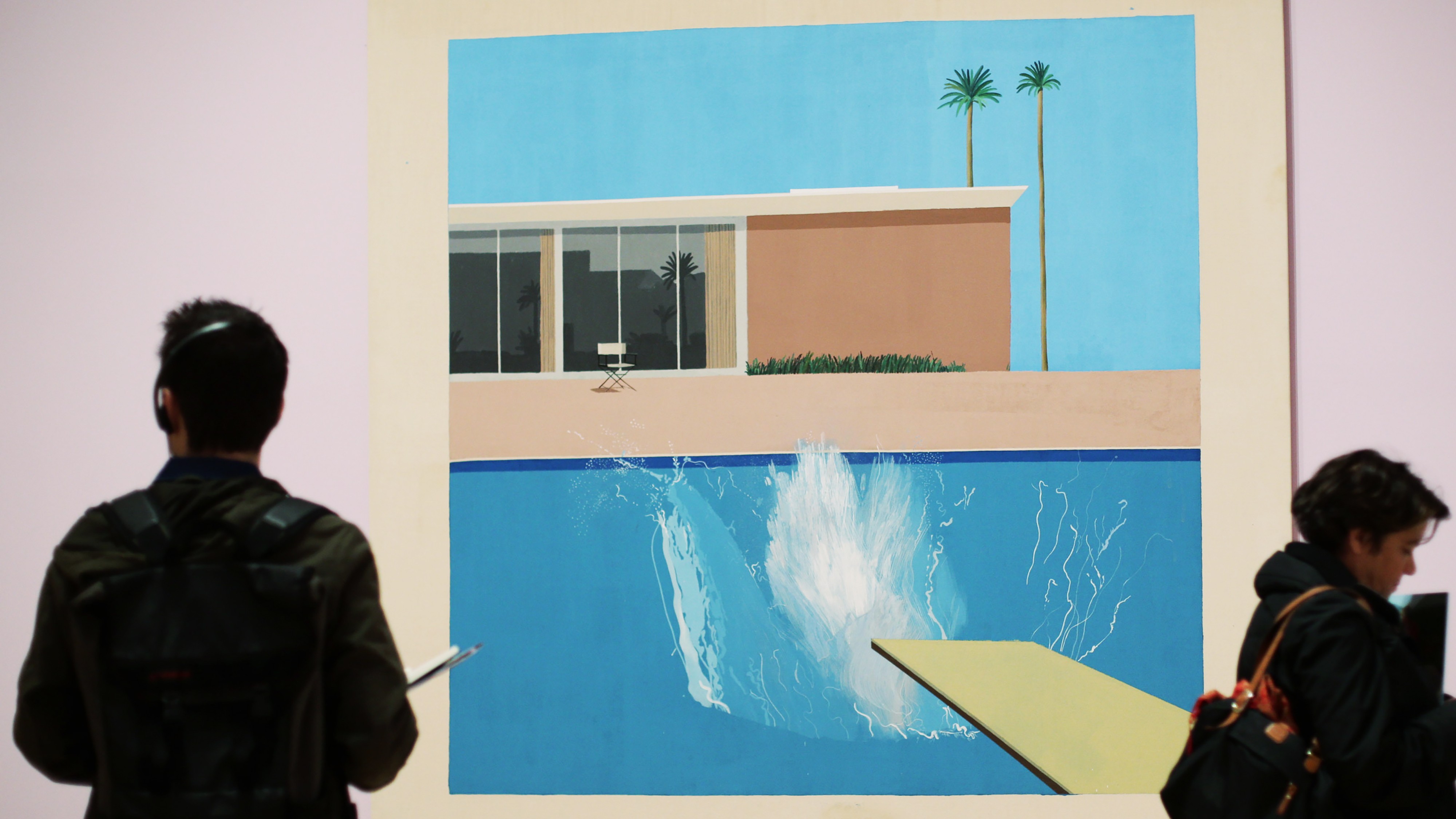
David Hockney Slowed Down Time
When David Hockney in the 1960s turned his attention to a photograph of a splash-splattered swimming pool, he did what most of us today, immersed in an endless stream of digital images, do not. He kept looking.For two weeks, the artist worked tirelessly from the photo to perfect his rendition in his acrylic painting A Bigger Splash, of the dancing droplets that erupted when some long-forgotten swimmer threw themselves into the deep end. The splash ended in an instant. Yet captured in Hockney’s most famous work, it lives on, an unremarkable backyard moment afforded the scrupulous attention of a royal portrait.In devoting such deep focus, Hockney, who died Thursday at the age of 88, restored something that had been lost in that original image. The artist thought that paintings and drawings have a certain depth that photography on its own lacks. He spoke of this with intensity in his later years, saying in a 2013 interview with Michael Govan, the director of the Los Angeles County Museum of Art, that photography “colored our vision” and might eventually “break something.” The medium, he noted, feels temporary. By contrast, “drawing,” he said, “takes time. A line has time in it.”If images today have a way of eating up time, keeping our fingers scrolling, Hockney’s works might be said to give it back. Perhaps this is why Hockney’s art can seem both in time and out of it. His paintings can feel like a respite for screen-addled eyes, even as they nod to technology’s ability to shape images.Many will remember Hockney as the bespectacled British painter of “sun-soaked” Los Angeles scenes, a master of mid-century Americana. But beyond the California glam is an effort to reckon with new ways of seeing—to reclaim what’s been lost in the modernity he so coolly depicts.[Read: David Hockney’s record-smashing $90 million painting]An artist who wielded paintbrushes and iPads alike, Hockney had a fascination with the mechanics of image-making. He wrote a book pushing much-debated the