The Anti-Singularity
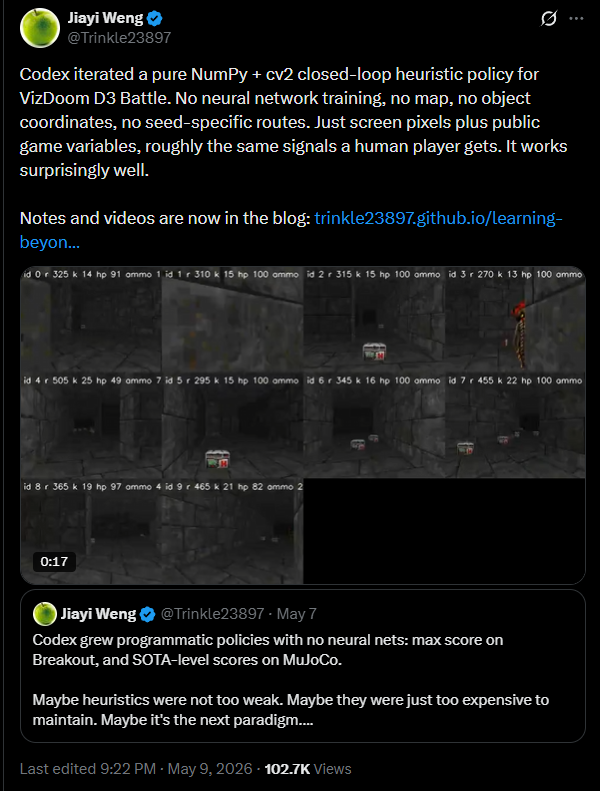
Heuristic solution to Doom generated by GPT-5.4In his blog post, Jiayi Weng proposes "the next paradigm" for Machine Learning: rather than trying to find beautiful abstractions for general-purpose-learning, we simply take advantage of LLM's ability to tirelessly iterate on complex designs to build heuristics that can solve whatever task-at-hand we are dealing with.I do not know whether this next paradigm is indeed the future or not (indeed I hope not) but I think it is at least worth considering the ramifications if it is.The SingularityIf you are reading this post, you are undoubtedly already familiar with the concept of the Singularity . As computers become better at learning, they eventually reach a level known as General Purpose AI (GAI) where they are able to perform all of the intellectual tasks that humans can do, but faster and cheaper. This leads to Recursive-Self-Improvement (RSI) where the AI improves itself, since one of the things humans are able to do is build GAI. Eventually RSI leads to Super-Intelligent AI (SAI), a single AI with godlike powers able to solve any conceivable problem, finally and truly defeat Moloch ushering in an age of unprecedented wealth and prosperity, and a sort of golden-age for Humankind where having finally completed our last invention we can finally relax and enjoy the fruits of our labors.While believers in the Singularity will frequently warn of its perils --if we don't seed the SAI correctly it may turn us all into paperclips-- belief in the Singularity is fundamentally a Utopian vision. Even a world turned into paperclips is perfectly turned into paperclips. Intelligence is a single, measurable concept and once it reaches its final form all will be arrayed beneath its command. The Anti-SingularityThe anti-singularity exists in a future where the utopian visions of singularity theorists do not merely end badly (as with a paperclip maximizer) but where they cannot come to pass because they are based on shaky philosophical