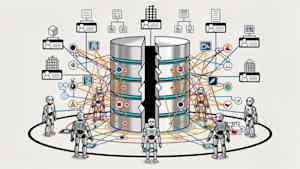
D&B's database of 642 million businesses was built for humans, not AI agents. So they rebuilt it.
Why this matters: a development in AI with implications for how people work, create, and decide.
Dun & Bradstreet has spent over 180 years building a comprehensive commercial database. Its Commercial Graph, covering 642 million businesses and their relationships, corporate hierarchies and risk profiles, was designed for people. Credit analysts, risk managers and sales professionals who could wait for query results and work through ambiguous entity matches. AI agents cannot do any of those things.When D&B's customers started pushing agents into credit, procurement and supply chain workflows, the Commercial Graph that had reliably served nearly 200,000 customers globally became a problem. The systems built to serve human analysts were the wrong architecture for machines. So D&B rebuilt."We need to think about agents as our new consumer category, evolving from our standard credit analysts or sales and marketing professionals, et cetera, to also now catering to these customers' agents," Gary Kotovets, Chief Data and Analytics Officer at Dun & Bradstreet, told VentureBeat.What broke when agents started queryingThe Commercial Graph was not a single database. It was a collection of separate systems built for different use cases and different markets, held together by custom integrations. Human analysts navigated that fragmentation through SQL queries or pre-built interfaces. Agents could not.The scale of the underlying data compounded the problem. The database had nearly doubled in five years, expanding from more than 300 million to more than 642 million business records, with 11,000 fields per record, according to D&B. The firm now runs approximately 100 billion data quality checks per month as records move through its systems. Querying that at the sub-second latency agents require, against a fragmented architecture, was not workable.The relationships the graph tracked were also the wrong kind. Legacy systems recorded static connections between entities. A CEO was linked to a company. That was the line. Agents working on credit assessments or third-party ri