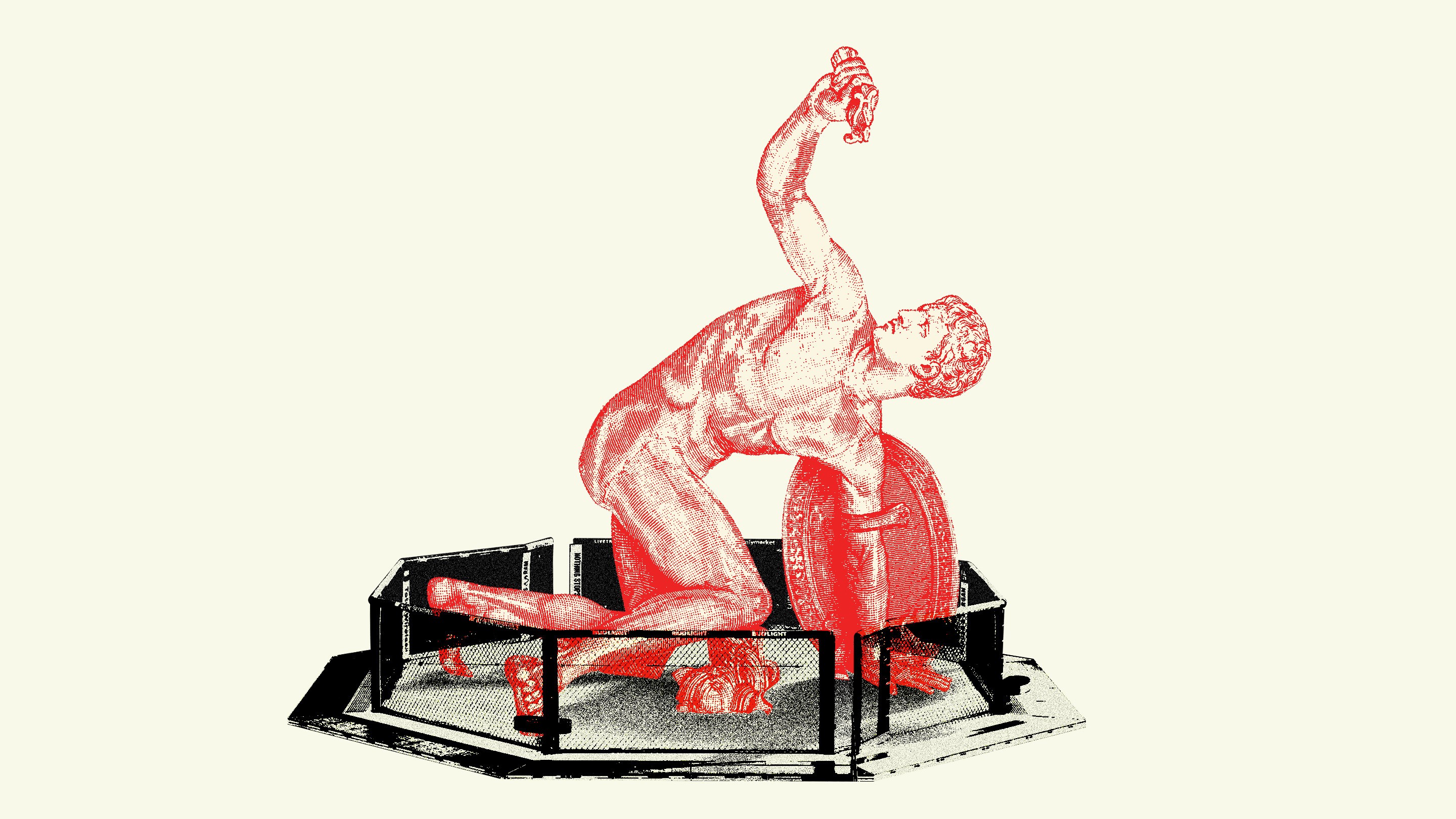
The Emperor Has No Ludus Magnus
The arena has been built. Its skeletal steel dome, erected on the spot where an Easter egg roll was held in the days of the republic, rises as high as the topmost arcade of the Colosseum, towering over the White House. UFC Freedom 250, to be streamed by Paramount, will feature seven bouts fought inside an octagonal wire-mesh cage. Many people have noted the similarities to ancient gladiatorial contests. President Trump himself will occupy an arena-level seat, positioned like a Roman emperor in his pulvinar—the imperial box—and surrounded by senators and dignitaries, if not the traditional six Vestal Virgins.Criticism has been predictable—the event smacks of excess. To me, though, what is most striking about the plans is their overall lack of ambition. True, the president has suggested that he might keep the steel dome in place—“Maybe we’ll never, ever take it down.” But the Roman gladiatorial spectacle involved more than just fighting; it spilled over into city planning, law, public health. In his single-minded focus on mounting a cage fight on a single day, the president has missed significant opportunities.[Bhumika Tharoor: What Donald Trump will never understand about fighting]For instance, where’s the school? Ancient arenas typically had a gladiator-training facility nearby, so that combatants could march in procession to the arena. (The UFC fighters in Washington plan to march from the Oval Office.) The biggest gladiator school in the Roman Empire was the Ludus Magnus, whose remains can be seen today in an excavated rectangle near the Colosseum. People close to Trump have dreamt of a latter-day Ludus Magnus for years. The onetime presidential adviser Steve Bannon has floated the idea of founding a “gladiator school for culture warriors” at a secluded monastery outside Rome. Creating a mixed martial arts facility close to the White House would be easy enough. The ruins of the Ludus Magnus look strikingly similar to the current ruins of the East Wing. Dorms, clas