America’s Promise
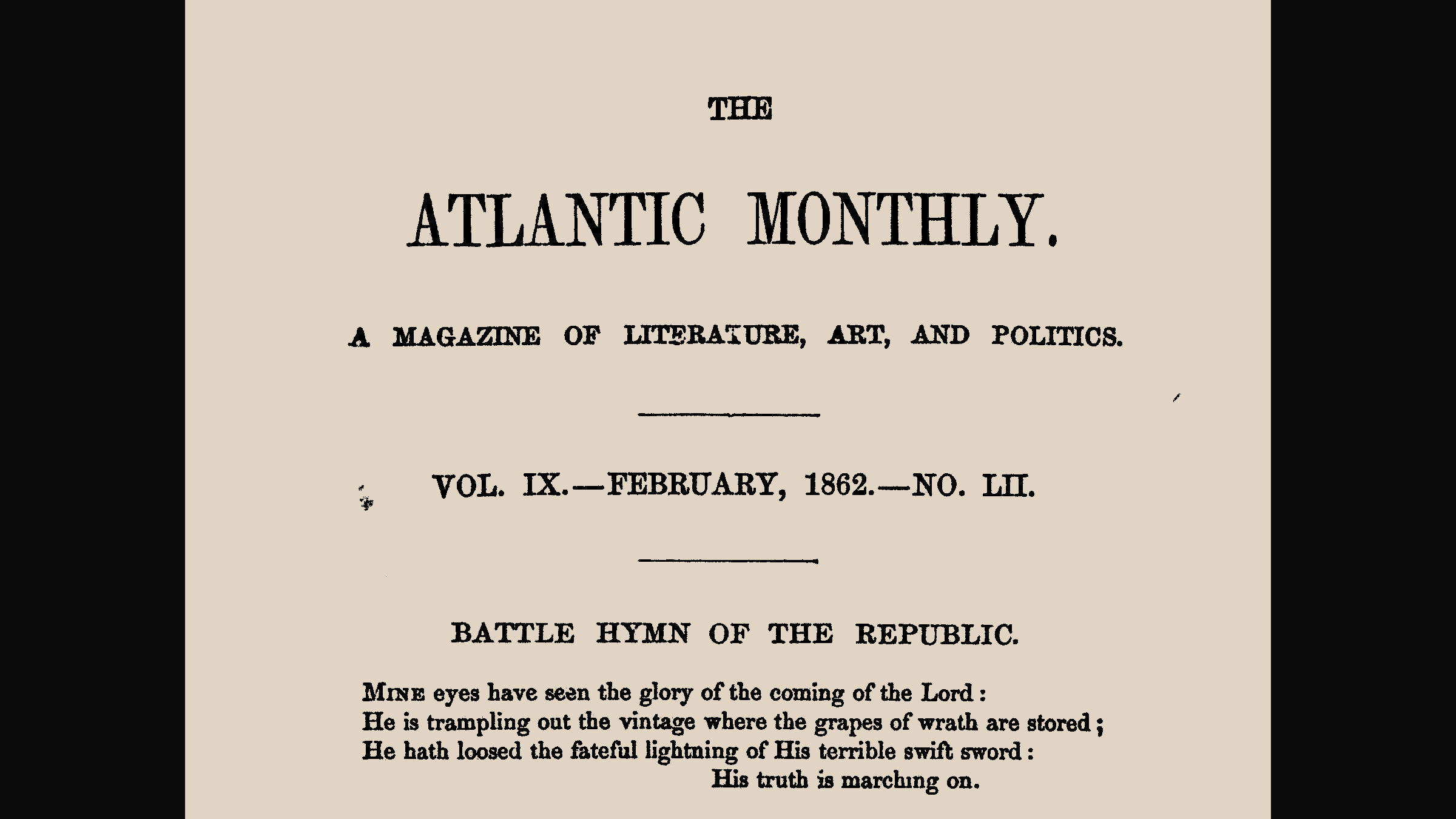
It is quite interesting, and somewhat chastening, to realize that the most important piece of journalism published across the 169-year history of this magazine was not journalism at all, but a poem, and that it was published so early in the life of The Atlantic. And it is particularly humbling to know that we will almost certainly never again publish something that so powerfully transcends space and time. The poem, “Battle Hymn of the Republic,” is one that, to borrow from its final stanza, “transfigures you and me.” We are featuring it on our cover this month in celebration of the 250th anniversary of the founding of the republic.Julia Ward Howe, the author of the “Battle Hymn”—she wrote it in one fevered night at the Willard Hotel, in Washington, D.C.—received either $4 or $5 for her submission. It was published in our February 1862 issue without her byline, as was then the custom. One of the many reasons we wanted the “Battle Hymn” to represent The Atlantic on the semiquincentennial anniversary of American independence is that it would allow us to print the poem with Howe’s byline on our cover for the first time. It’s the least we could do, given all that she did for this magazine, and for her country as an abolitionist and a suffragist. And also because writing seemed, at times, so difficult for her.In a note to the editor of this magazine, James T. Fields, that she attached to her submission, Howe wrote: “Fields! Do you want this, and do you like it, and have you any room for it in January number?” She went on, “I am sad and spleeny, and begin to have fears that I may not be, after all, the greatest woman alive. Isn’t this a melancholy view of things? But it is a vale, you know. When will the world come to end?”[Read: The Civil War]Fields, to his credit, accepted the poem (we do not know if he also tried to soothe Howe’s anxiety). He also gave it its grand, martial, and commanding title.The question arises: What does the “Battle Hymn,” written to prepare the Un