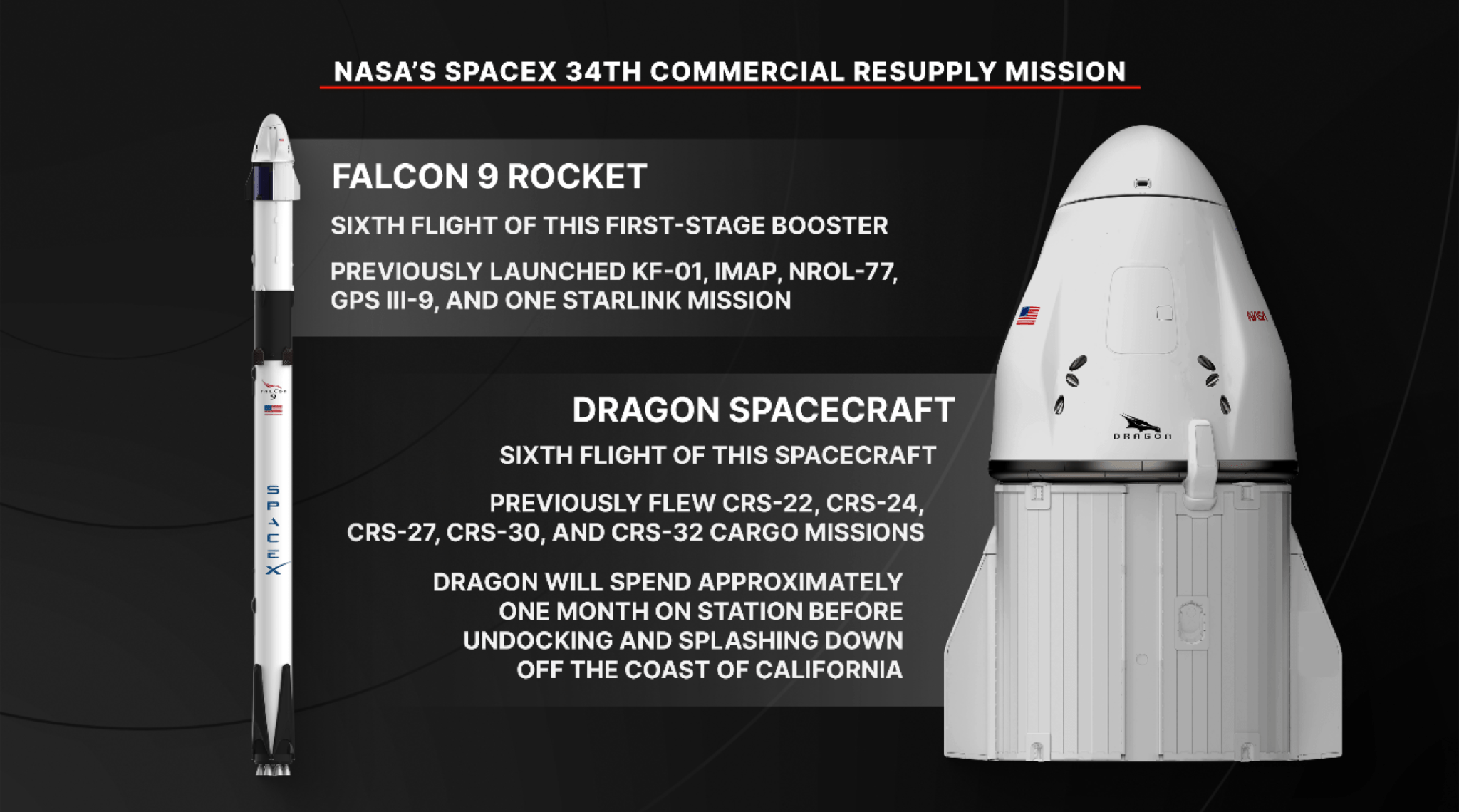
NASA’s SpaceX 34th Commercial Resupply Mission Overview
Why this matters: new research or scientific developments with potential real-world impact.
NASA’s Space X 34th commercial resupply mission will launch on the company’s Dragon spacecraft on the Space X Falcon 9 rocket to deliver research and supplies to the International Space Station.NASA NASA and Space X are targeting a mid-May launch to deliver scientific investigations, supplies, and equipment to the International Space Station. Loaded with about 6,500 pounds of supplies, the Space X Dragon spacecraft will lift off aboard the company’s Falcon 9 rocket from Launch Complex 40 at Cape Canaveral Space Force Station in Florida. Following its arrival to the orbital complex, Dragon will dock autonomously to the forward port of the space station’s Harmony module. Watch agency launch and arrival coverage on NASA+, Amazon Prime, and NASA’s YouTube channel. Learn how to watch NASA content through a variety of online platforms, including social media. NASA’s SpaceX 34th commercial resupply mission will launch from Launch Complex 40 at Cape Canaveral Space Force Station in Florida.NASA For more than 25 years, the International Space Station has provided research capabilities used by scientists from more than 110 countries to conduct more than 4,000 experiments in microgravity. Research conducted aboard the station helps advance long-duration missions to the Moon as part of the Artemis program and to Mars, while providing multiple benefits to humanity. Science highlights: In addition to cargo for the crew aboard the space station, Dragon will deliver several new science experiments, including: ODYSSEY will evaluate how well Earth-based microgravity simulators recreate space conditions.NASA ODYSSEY will evaluate how well Earth-based microgravity simulators recreate space conditions. Researchers will examine bacterial behavior in space and compares the results to experiments conducted in microgravity simulators on Earth. STORIE will monitor charged particles in orbit around the Earth, which respond to space weather and can affect assets like power grids and satellites.NAS