Explaining Volition Without Resorting to Free Will
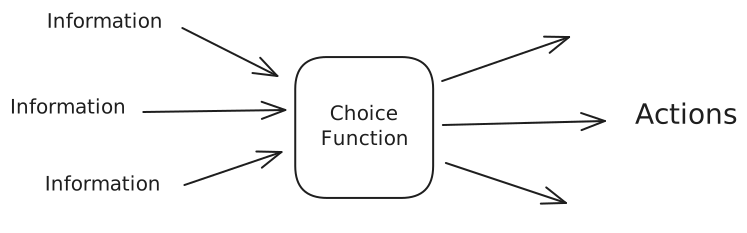
People often use free will to explain how we make choices, but have great difficulty explaining how free will itself works. Philosophers gesture towards ideas like "the capacity to choose" or "the freedom to do otherwise", but these concepts just raise the same question to me: What are "capacity" and "freedom"? I suspect that the reason free will is so hard to explain is because it is not actually clarifying anything. It's a fake explanation, like the physics textbook that says everything runs on energy.[1] "What makes the bicycle move?" Energy! "How do we make choices" Free will! It doesn't really answer anything.However, most people do feel like they make choices. I think making choices is a real phenomenon, just that the answer isn't "free will". When I want to answer the question of how we make choices, I look at the process by which it occurs. For me, that consists of gathering information to determine the best action, and then performing that action. If you look at it from a purely mechanistic lens, choice-making is simply following some function from information to actions:From this perspective, many things make choices that we might not traditionally consider to have free will. For example, my computer chooses which threads to schedule on which processors.Nevertheless, there is definitely a difference between a computer and myself. Someone programmed the computer to make its choices, but I make my own choices. What explains the difference between us?I think it's simply a matter of self-reference and bootstrapping. The computer doesn't write its own code (at least, not yet), but we modify our own choice functions. Namely, given certain kinds of information—such as that an action led to a suboptimal outcome—our choice functions output actions to modify themselves. When the choice function is sufficiently clever, it can even realize that these updates may be suboptimal, and bootstrap itself to an even cleverer choice function. Eventually, the choice function is