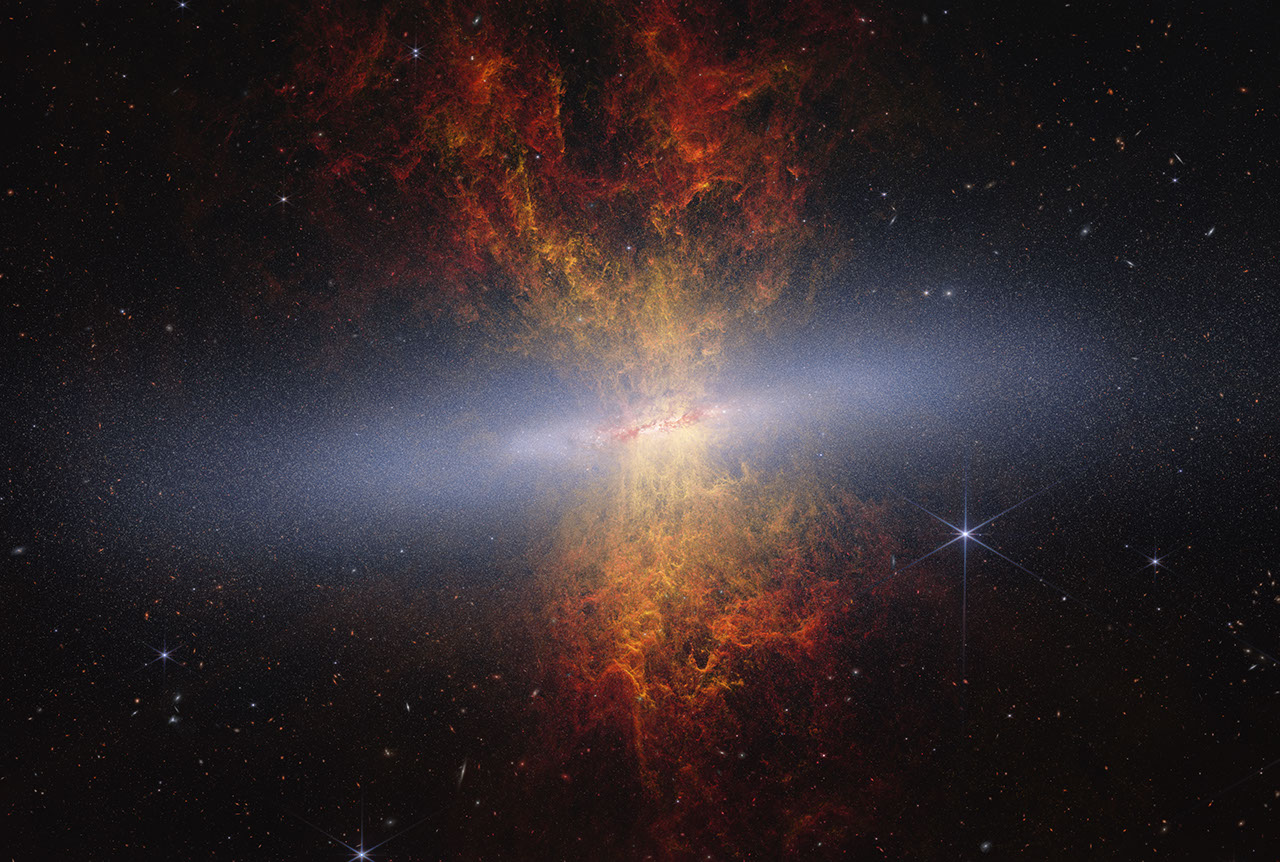
NASA’s Webb Pinpoints Millions of Stars Within Cigar Galaxy
Why this matters: new research or scientific developments with potential real-world impact.
Explore Webb Science James Webb Space Telescope (JWST) NASA’s Webb Pinpoints… Webb News Latest News Latest Images Webb’s Blog Awards X (offsite – login reqd) Instagram (offsite – login reqd) Facebook (offsite- login reqd) Youtube (offsite) Overview About Who is James Webb? Fact Sheet Impacts+Benefits FAQ Webb Timeline Science Overview and Goals Early Universe Galaxies Over Time Star Lifecycle Other Worlds Science/Engineering Explainers Observatory Overview Launch Deployment Orbit Mirrors Sunshield Instruments & ISIM Module Instrument: NIRCam Instrument: MIRI Instrument: NIRSpec Instrument: FGS/NIRISS Optical Telescope Element Backplane Spacecraft Bus Webb vs Hubble -> Multimedia About Webb Images Images Videos What is Webb Observing? 3d Webb in 3d Solar System Podcasts Webb Image Sonifications Webb’s First Images Team International Team People Of Webb More For the Media For Scientists For Educators For Fun/Learning 6 Min Read NASA’s Webb Pinpoints Millions of Stars Within Cigar Galaxy Scientists used NASA’s James Webb Space Telescope to image edge-on starburst galaxy Messier 82 and trace its evolutionary history. This Webb and Hubble composite image includes 16.5 million stars (blue-white), dust grains (red-orange), and ionized hydrogen gas (yellow). Credits: Image: NASA, ESA, CSA, Adam Smercina (STScI, Tufts), Thomas Williams (University of Manchester); Image Processing: Alyssa Pagan (STScI) Located 12 million light-years away and undergoing rapid star formation, edge-on spiral galaxy Messier 82 (M82) is a scientifically unique sight to behold, and now NASA’s James Webb Space Telescope has revealed previously unseen details. M82’s intense star formation, thought to be the result of a galaxy merger, will be a short-lived event in astronomical terms, estimated to last a few hundred million years in its entirety. This temporary phase of extreme star formation relative to the galaxy’s mass, as well as its location in the local universe, are among the factors that