NASA Says Farewell to MAVEN Mars Mission, Hosts Media Call Today
Why this matters: new research or scientific developments with potential real-world impact.
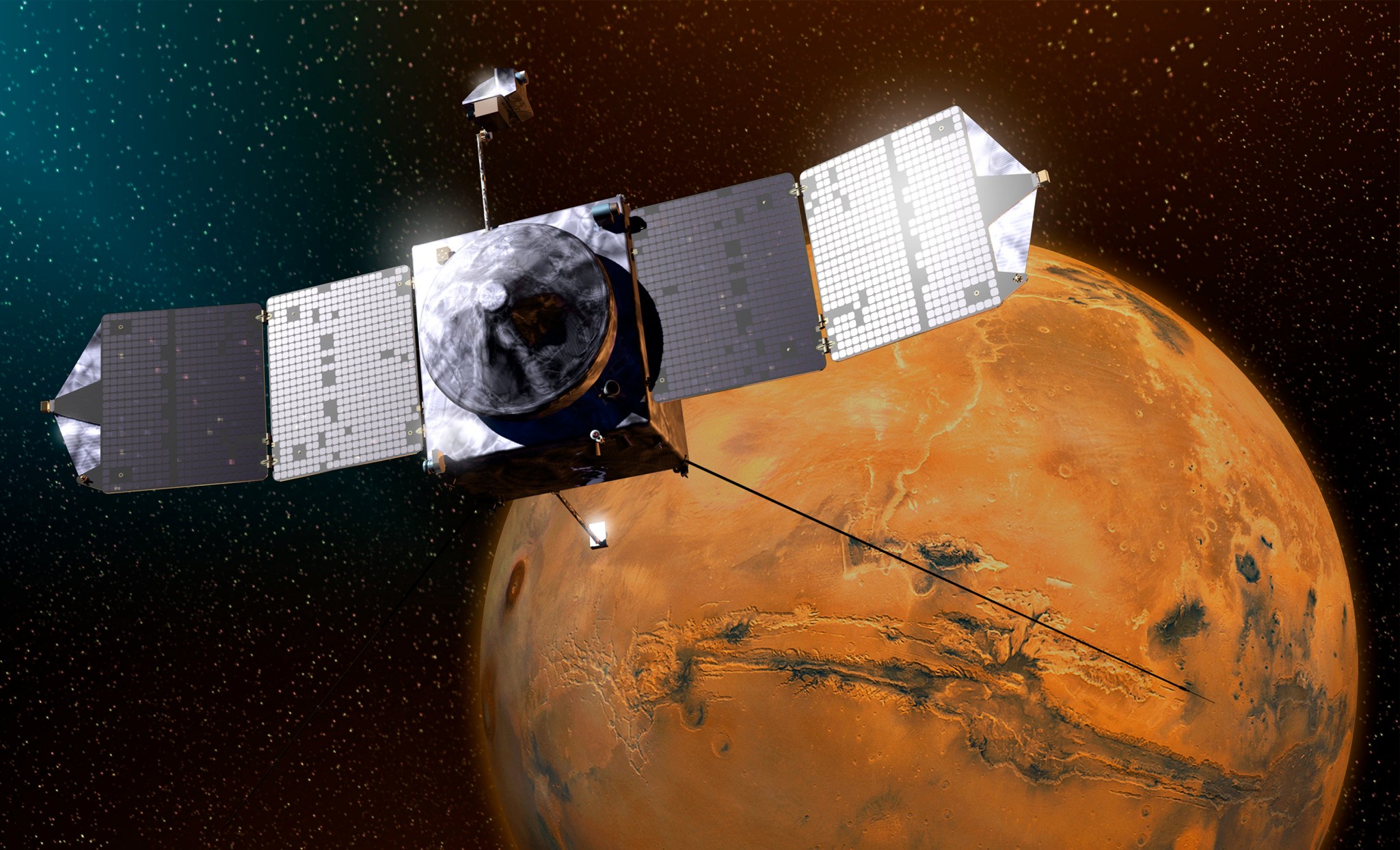
Artist’s concept of NASA’s MAVEN spacecraft at Mars. The spacecraft entered orbit around the planet in 2014 and has completed over eleven years of observing the Martian upper atmosphere, ionosphere, and interactions with the Sun and solar wind to explore the loss of the Red Planet’s atmosphere to space. Credit: NASA/Goddard/University of Colorado/Laboratory for Atmospheric and Space Physics. The first mission devoted to observing the Martian atmosphere and its evolution, NASA’s MAVEN (Mars Atmosphere and Volatile Evolution), has ended after more than 11 years in orbit at Mars and a decade beyond its primary, one-year mission. The spacecraft was heard last on Dec. 6, when it experienced an unexpected loss of signal after it passed behind the Red Planet. NASA will host a media teleconference at 2 p.m. EDT today, Wednesday, June 3, to discuss MAVEN’s achievements. The agency convened an anomaly review board in February to evaluate recovery efforts and assess the spacecraft’s probable current state. The review board has determined that the MAVEN spacecraft is not recoverable, and it is no longer capable of performing its science and data relay mission, which is consistent with the mission team’s findings. Telemetry from MAVEN prior to the spacecraft’s passage behind Mars in December showed all subsystems working normally. After the spacecraft emerged, NASA’s Deep Space Network (DSN) did not observe a signal. A brief fragment of telemetry data from analysis of radio signals recorded by the DSN’s open-loop receivers indicated the spacecraft was in safe mode and rotating at an unusually high rate when it emerged from behind Mars, indicating a disruption in MAVEN’s orbit trajectory. The review board concluded that due to this rotation, the batteries on the spacecraft had drained, causing the communications system to lose power and rendering MAVEN in an unrecoverable state. These preliminary findings do not address a potential root cause for the anomaly, which still is