NASA’s MAVEN Makes 1st Discovery of Atmospheric Effect at Mars
Why this matters: new research or scientific developments with potential real-world impact.
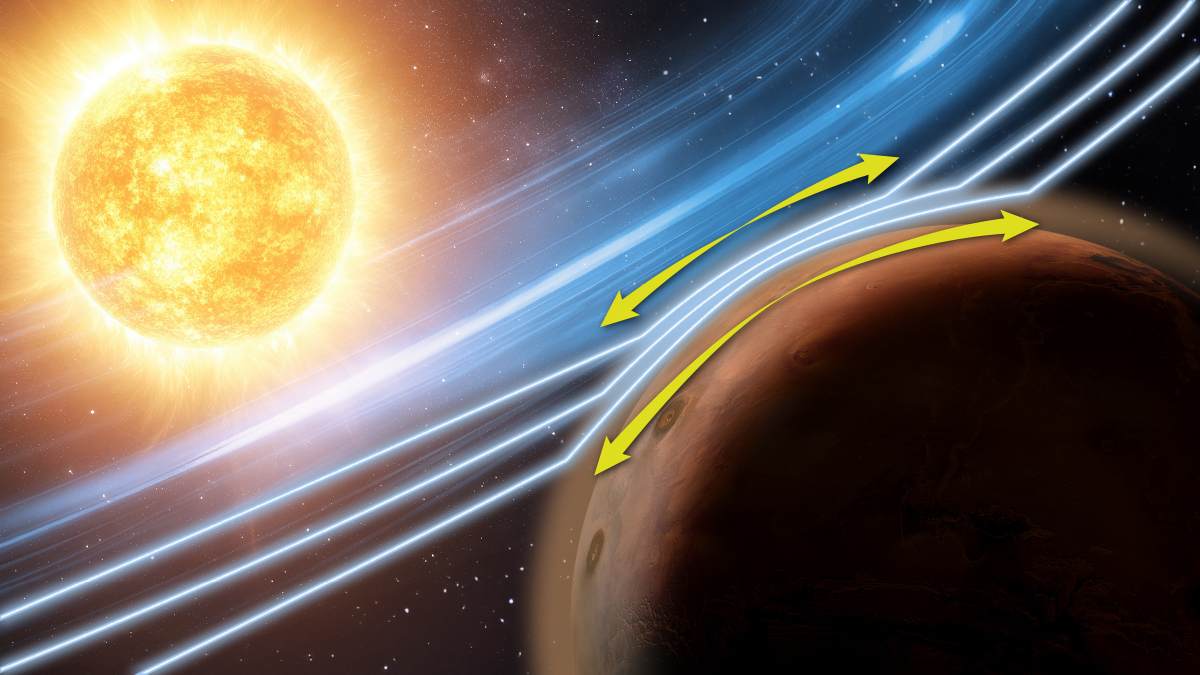
In December 2023, scientists looking at Mars data stumbled across something completely unexpected — observations of an atmospheric effect never before seen in the Red Planet’s atmosphere. Using instruments aboard NASA’s MAVEN (Mars Atmosphere and Volatile Evolution) mission, scientists identified a phenomenon known to occur in Earth’s magnetosphere, where charged particles are squeezed like toothpaste coming out of a tube along magnetic structures called flux tubes. This so-called Zwan-Wolf effect aids in the deflection of solar wind around Earth and has been observed and studied there for decades. Now, a new study published in Nature Communications provides the first comprehensive observations of the same effect in Mars’ atmosphere. An artistic representation of the Zwan-Wolf effect at Mars, as observed by NASA’s MAVEN (Mars Atmosphere and Volatile Evolution) mission. While this effect typically helps to deflect the solar wind at Earth, at Mars it is shown to “squeeze” the atmosphere and have implications on how space weather interacts with the planet. The yellow arrows represent the movement of the effect in the Martian atmosphere. LASP/CU Boulder “When investigating the data, I all of a sudden noticed some very interesting wiggles,” said Christopher Fowler, a research assistant professor at West Virginia University in Morgantown and lead author of the study. “I would never have guessed it would be this effect, since it’s never been seen in a planetary atmosphere before.” The Zwan-Wolf effect was first discovered in 1976, and until now has only been observed in planetary magnetospheres, not their atmospheres. Unlike Earth, Mars is not protected by a global magnetic field, affecting how it interacts with the solar wind and space weather. In this new study, the Zwan-Wolf effect was observed in the ionosphere — deep within the Martian atmosphere below 200 km — which contains significant numbers of electrically charged particles. The data showed that these charged par