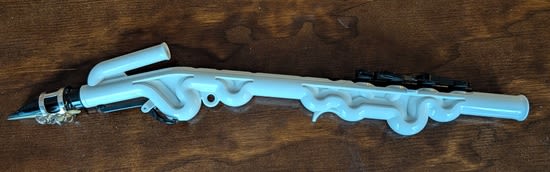
Dual Bore Janko Venova
I recently got a Venova and have been enjoying learning how to play it: It combines a saxophone mouthpiece with recorder fingering and a little nose to overblow an octave instead of a twelfth. It's somewhere between a real instrument and a toy, and one of its bigger problems is that while it's great in C it gets harder to play the more sharps or flats you want. Since I mostly play contra music, typically in 2-3 sharps, this isn't ideal. A Venova in D (two sharps) would be great, but I don't see this coming. If we're going to put in a bunch more work somehow, what if we went all the way to a double bore? Imagine two parallel bores with the tone holes lined up exactly, so that when you put your finger down it covers both. The holes would look a bit like the double holes on a recorder, but they could be closer together because you never need to cover just one of them: The obvious way to do it, and the equivalent of a B/C melodeon, is a C tube for the "white keys" and a B tube for the "black keys": between them you can play every note. The venova already uses a "meandering bore" to bring the holes closer together: to keep them in tune you put slightly larger meanders all along the B bore so the wavelength is consistently a half step longer. Then you need some way to choose which bore the air flows through, so only one is active at once. We could borrow from the solutions brass instruments have come up with. Since those are solving a much harder problem (routing air through a loop) we can do something simpler. I think a flapper valve would be a better fit: much cheaper to make, and more moisture resistant. When you think about B/C fingering, though, you'll notice that we're using one bore for 7 notes, and the other for 5. Let's take inspiration from a Janko keyboard and do 6 and 6: two sets of whole steps, a half step apart. One bore would be C, D, E, F#, G#, Bb while the other would be C#, D#, F, G, A, B. This lets you use your left thumb for the valve, left forefinger