A (Slightly) Mechanistic Theory for Exponentially Increasing AI Time Horizons?
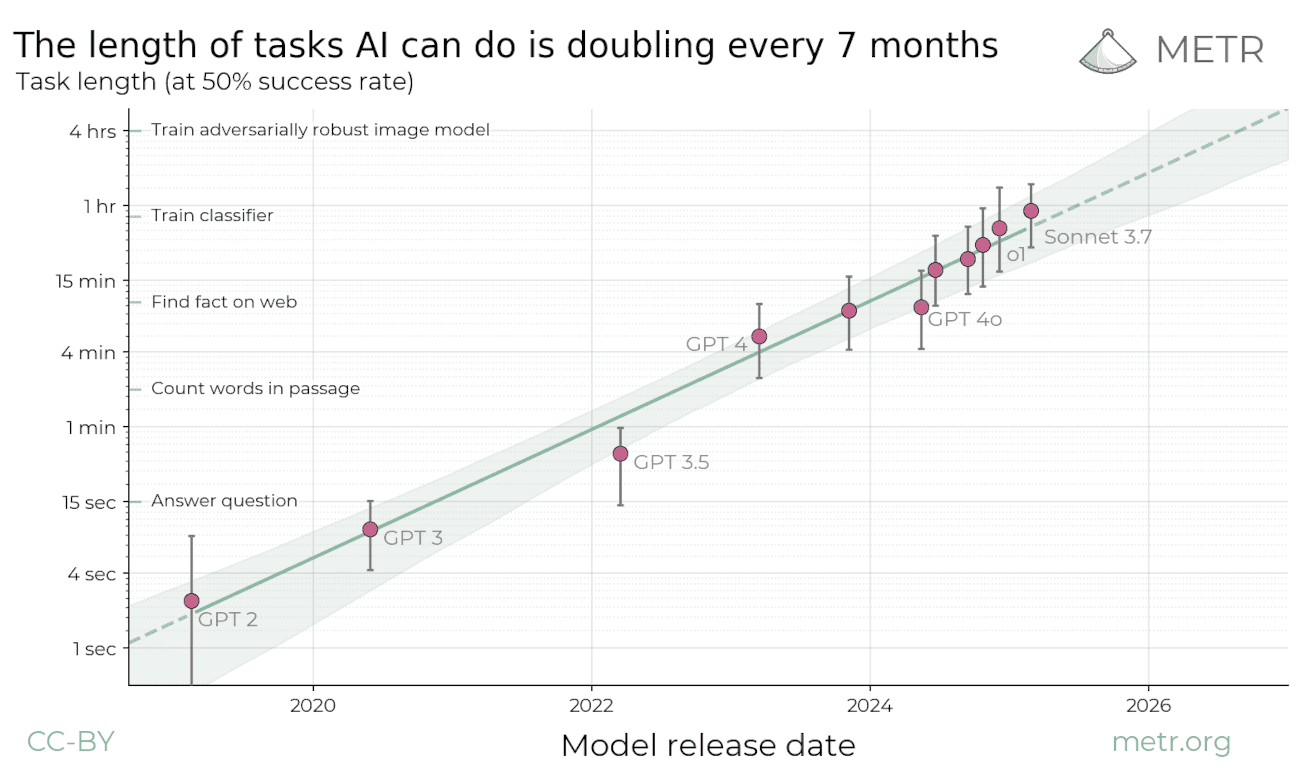
AI ‘time horizons’ are mostly not about time (I think it’s mostly ‘data’, but you’ll see where I’m unsure).One chart from 2025 has become perhaps the most (in)famous in modern AI commentary.For those in the know, ‘the METR graph’[1] is unusually compelling because it achieves what so few measures of AI progress have achieved: a somewhat meaningful Y axis (‘time horizon’[2]) as well as a somewhat predictable trend over time! (This is remarkably rare!)Frustratingly, the only superficially available takeaway is something like, ‘the line goes up straight-ish over time’. This is better than nothing, but it’s very dissatisfactory from the point of view of getting confidence in the predictions, because it exposes no deeper mechanism. This drives a lot of confusion and argument about the implications.A deeper mechanism would be good for two reasons:It enables a sanity check on the trend, perhaps enabling more confidence in its predictions than we would sensibly allow with only the surface understanding.It gives some way to interrogate when and how the trend might change (because if the deeper mechanism gets deflected, the superficial projection would be broken, but a prediction based on the deeper mechanism might stay viable for longer).(A sub-reason: if we want the trend to change, knowing some more mechanism might shed light on some levers to pull rather than sitting around to wait and see.)As an analogy, a similarly superficial trend, Moore’s Law, can be a little better mechanistically explained by the more general Wright’s Law[3]. This is great, because that law covers more cases, and it can handle some deflection from the trend, or give some idea of when (and under what conditions) the trend might break. Important when looking at plausible futures, and how to steer toward desirable ones!Attempting to find some mechanism in the METR graphTask ‘length’ and success modellingWhy did METR focus on ‘task length’?First, it’s not how long the AI agent takes. It’s how long the