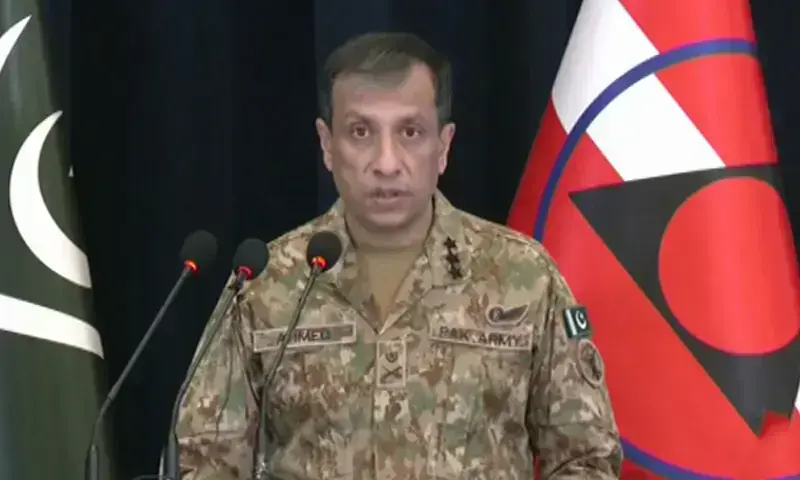
'We are prepared': DG ISPR highlights Pakistan's indigenous military capabilities
Why this matters: local context for readers following news across Pakistan and the region.
Inter-Services Public Relations (ISPR) Director General Lt Gen Ahmed Sharif Chaudhry said on Thursday that Pakistan was “prepared” as he touted the armed forces’ indigenous military capabilities. He made the remarks while addressing a press conference in Islamabad as the nation commemorated the one-year anniversary of Marka-i-Haq. The deputy chief of naval staff (operations), Rear Admiral Shifaat Ali, and the deputy chief of air staff (projects), Air Vice Marshal Tariq Ghazi, were also present alongside him. Last year’s military conflict with India, starting from the April 22 Pahalgam attack to the end of Pakistan’s Operation Bunyanum Marsoos, with a ceasefire ending a military escalation between the two countries on May 10, has been called “Marka-i-Haq” (Battle of Truth) by the state. “We welcome you to ISPR on this happy day,” he said at the outset of his presser, congratulating the nation on the one-year anniversary of Marka-i-Haq. He said that the country’s armed forces had risen to the nation’s expectations and defeated a much larger enemy with multi-domain operations. “Today, we are not going to dwell a lot on what happened … We are going to spend more time from May 2025 to May 2026,” he said, adding that they would expand on the “strategic consequences” of the conflict. Strategic consequences of Marka-i-Haq He said that there were 10 strategic consequences of Marka-i-Haq, the first of which was that the Indian narrative of painting Pakistan as a source of terrorism stood buried. He said that an attempt had been made to portray, without evidence, that Pakistan had perpetrated terrorism in India. He said that it had been one year since the Pahalgam incident, yet the questions that Pakistan had asked remain unanswered. “Where is the evidence?” he asked. “Nobody buys this … you are the biggest terrorist. Nobody listens to them, nobody believes them,” he said. He said that the second consequence was the consolidation of Pakistan as the net security stabiliser in t