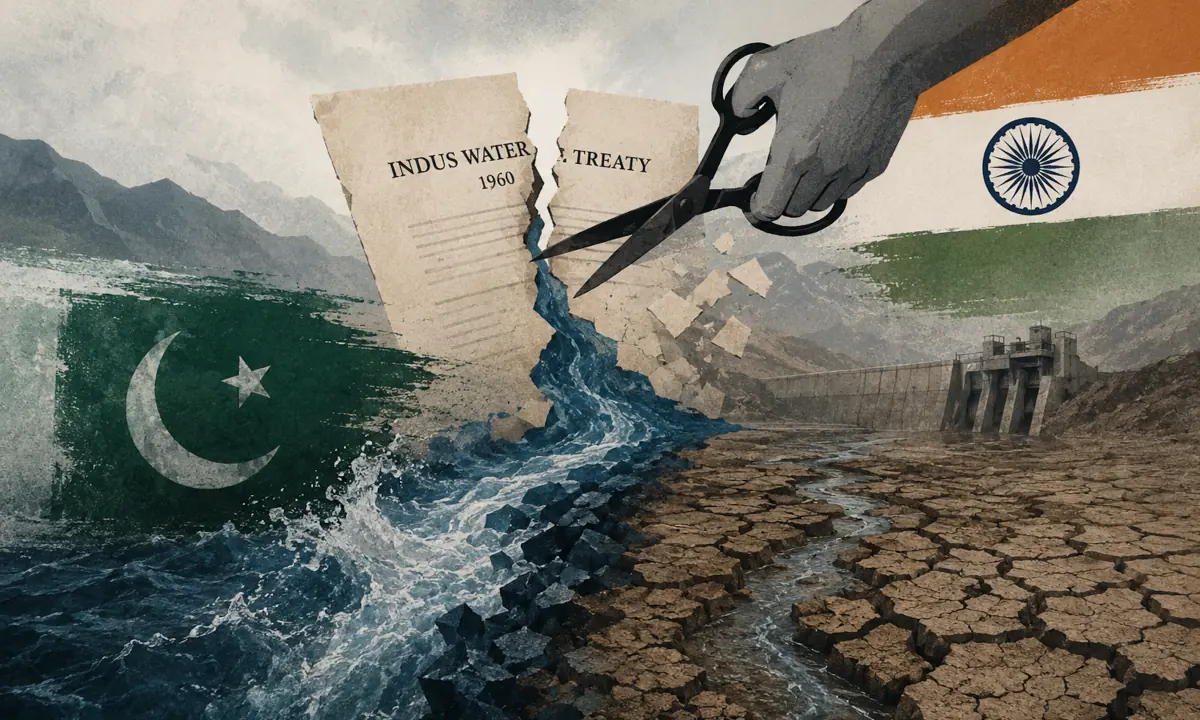
Blood, iron and water: India's riparian hypocrisy
Why this matters: local context for readers following news across Pakistan and the region.
South Asia teeters precariously upon a powder keg of existential volatility, ironically fuelled by water itself. This dangerous moment has been propelled by Prime Minister Narendra Modi’s flagitious and untenable proclamation that the waters of the Indus basin belong exclusively to India. One reaches this sombre conclusion after reading the incisive column by Ahmar Bilal Soofi, titled “Dams on Chenab — a target?”. A leading jurist, Soofi has consistently advocated rigorous legal remedies against Modi’s malevolent suspension of the Indus Waters Treaty (IWT) of 1960 — an act tantamount to de facto abrogation, devoid of legitimacy under the principle of pacta sunt servanda. This assertion by New Delhi not only repudiates solemn treaty obligations but weaponises a vital shared resource, imperilling the agrarian lifelines of downstream Pakistan. India’s hypocrisy Indian policy discourse seeks to cloak accelerated projects on the Chenab, including the colossal Sawalkote endeavour, under the guise of legitimate upper-riparian rights and energy needs. While claiming adherence to run-of-the-river constraints, such literature conveniently ignores the foreseeable consequences: diminished flows, ecological devastation, and an existential threat to food sovereignty for over 250 million people dependent on the Indus irrigation system. The hypocrisy stands glaringly exposed when juxtaposed against India’s vehement remonstrations as a lower riparian state in regards to river Brahmaputra on its north-eastern border. As a lower riparian, New Delhi invokes principles of equitable utilisation and the duty to cause no significant harm — yet behaves with unrestrained imperiousness when occupying the upper riparian position. Pakistan’s position rests on firm juridical foundations. The IWT’s annexures strictly limit Indian activities on the western rivers to preserve perennial flows. By explicitly linking dam construction to punitive objectives, as evidenced by ministerial declarations tha