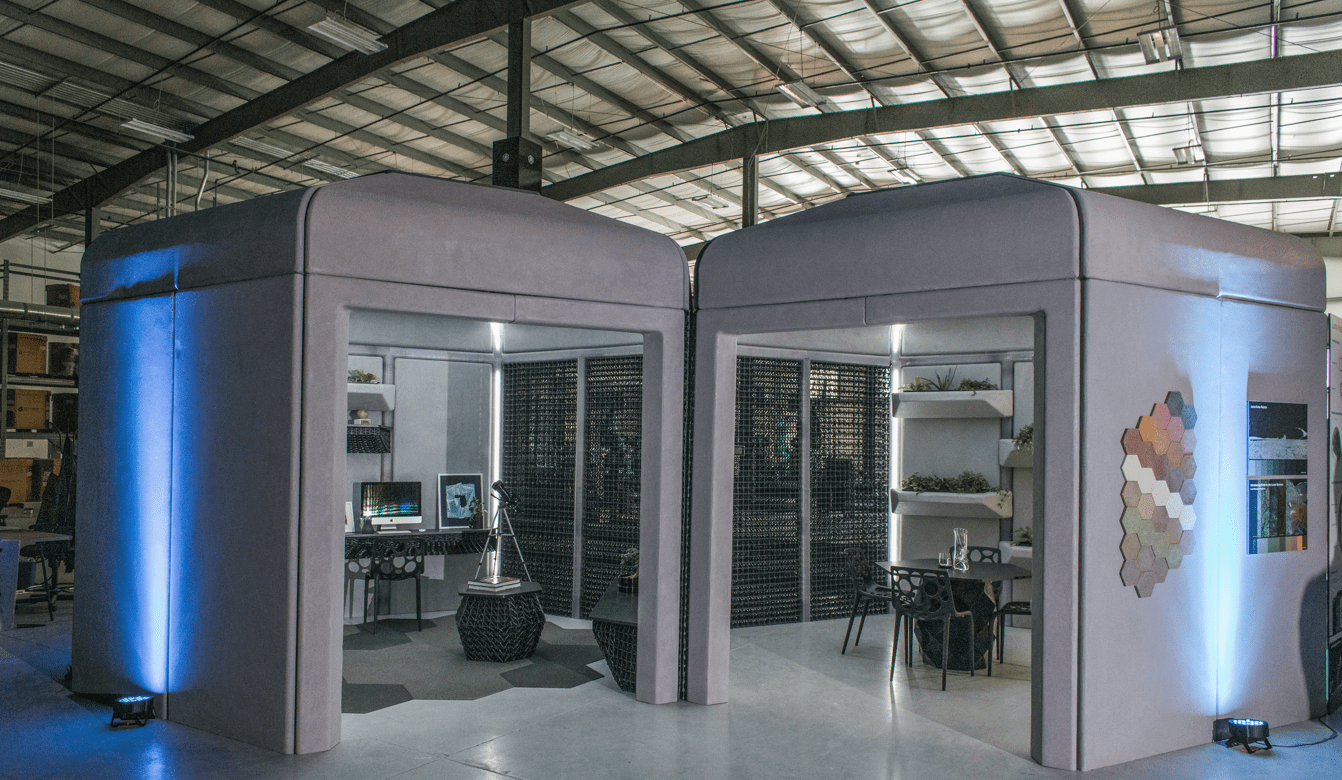
NASA-Supported Space Tech Advances Earthly Construction
Why this matters: new research or scientific developments with potential real-world impact.
An innovative 3D printing process that advanced NASA’s approach to outfitting a lunar habitat is making buildings on Earth beautiful, efficient, and strong. Instead of building structures layer by layer, Branch Technology Inc. of Chattanooga, Tennessee, has developed a process the company calls Freeform 3D Printing, which creates shapes with lightweight lattice structures that can be filled or covered. The company uses the technique to manufacture visually interesting, modular building elements, such as wall panels and cladding. “Our process eliminates a ton of material from something that otherwise might be printed solid all the way through,” said David Goodloe, who leads Branch Technology’s Advanced Concepts team, which manages the company’s NASA collaborations. In 2017, the company won Phase II of NASA’s 3D-Printed Habitat Challenge, a public competition to build a habitat for deep space exploration. Tracie Prater, a technical manager in the Habitat Systems Development Branch at NASA’s Marshall Spaceflight Center in Huntsville, Alabama, served as a subject matter expert for the challenge and worked with Branch Technology on a cooperative agreement. “With the 3D-Printed Habitat Challenge, teams were focused on how to build a large habitat structure on a planetary surface,” said Prater. “But once that structure is pressurized and ready for crew occupancy, how do you populate it with systems and supplies? That’s what Branch was looking at through the cooperative agreement — what their on-demand fabrication process enables in terms of novel designs for interior items.” NASA’s parameters for the habitat challenge led Branch to develop its nozzles to extru