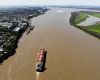
Paraná waterway: Milei's largest privatization advances amid tailored-bid suspicions
Key takeaways
- The process, which President Javier Milei's administration is presenting as one of the most significant privatizations of his term, has been run by the National Ports and Navigation Agency (ANPyN).
- A group of opposition lawmakers requested the tender's suspension after alleging that a technical report attributed to the United Nations had been forged.
- The same sources named businessmen Juan Ondarcuhu and Gustavo El as as candidates to operate the signaling segment.
Why this matters: an international story with cross-border implications worth tracking.
The tender to concession Argentina's Paran -Paraguay waterway for 25 years —the country's main fluvial artery, through which roughly 85% of foreign trade is shipped— has entered its final stretch with two Belgian finalists, Jan de Nul and DEME, and mounting political questions over the tender's design, the local partners involved, and the integrity of the supporting technical documentation.
The process, which President Javier Milei's administration is presenting as one of the most significant privatizations of his term, has been run by the National Ports and Navigation Agency (ANPyN). In the technical evaluation, Jan de Nul —partnered with Argentine firm Servimagnus— scored 66.2 points and DEME 42.14. Brazilian competitor DTA Engenharia was disqualified for failing to meet the required guarantees. The opening of the economic bids is expected in the coming days and will determine who will operate the dredging and signaling of a corridor that is strategic for Argentina, Paraguay, Bolivia, Uruguay, and southern Brazil. The concession is awarded on a tolling basis, without state guarantees and at the operator's risk.
The process has drawn controversy. A group of opposition lawmakers requested the tender's suspension after alleging that a technical report attributed to the United Nations had been forged. The Government maintains that the procedure was audited by the United Nations Conference on Trade and Development (UNCTAD), which certified the technical qualifications of the bidders. The Argentine Port Council and the Office of Administrative Investigations have also received objections, mainly concerning future tariff levels and the environmental studies tied to deeper dredging.