Systems Dynamics Model for Pausing AI
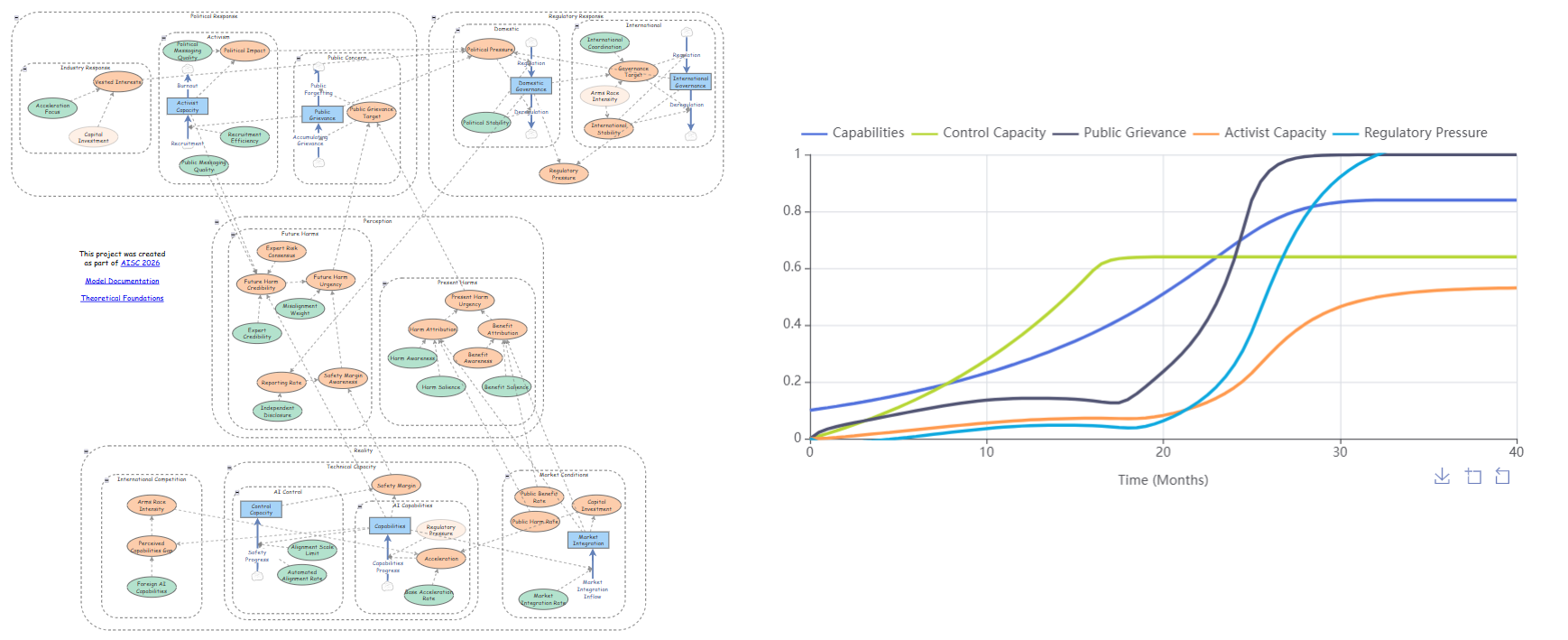
Summary. This post documents our process of applying systems dynamics modeling to the problem of AI governance, tracing the feedback loops connecting capability development, public harm, and regulatory constraint. Our research outputs include a model created in Insight Maker, step-by-step documentation, and a set of causal narratives informing the design. We also have a video presentation that covers the same material as this post. This project was part of AISC 2026.Background. A system dynamics model is a diagram with stocks, flows, user-set parameters, and calculated variables that can be used to generate a simulation, such as a line graph showing the projected state of key variables over time. Visual diagrams are useful for describing interconnected systems, compared to writing which is inherently linear. Simulation is useful for generating “what-if” scenarios, often of the form: how will the trajectory of variable X change as I raise/lower variables A, B, and C? Moreover, it helps to highlight which variables are more salient to a given problem, which may not be obvious at a glance.Figure 1: SD model (left), simulation output (right)Such implications are, however, entirely dependent on the assumptions of the model. Modelling a large, complex, and novel subject like the intersection of AI development and international governance requires stacking many deeply uncertain—and often controversial—claims, making the end result somewhat arbitrary. Scientists often prefer parsimonious and defensible models with empirical and theoretical grounding. However, given the complexity and novelty of the subject, we find more value by working in the opposite direction: the model encodes our beliefs about causal structure and our intuitive sense of plausible outcomes acts as a constraint on those beliefs. That is, if an outcome is implausible then the logic that generated it should be reconsidered.The Reification TrapThe use of System Dynamics (SD) modelling as a way of understanding