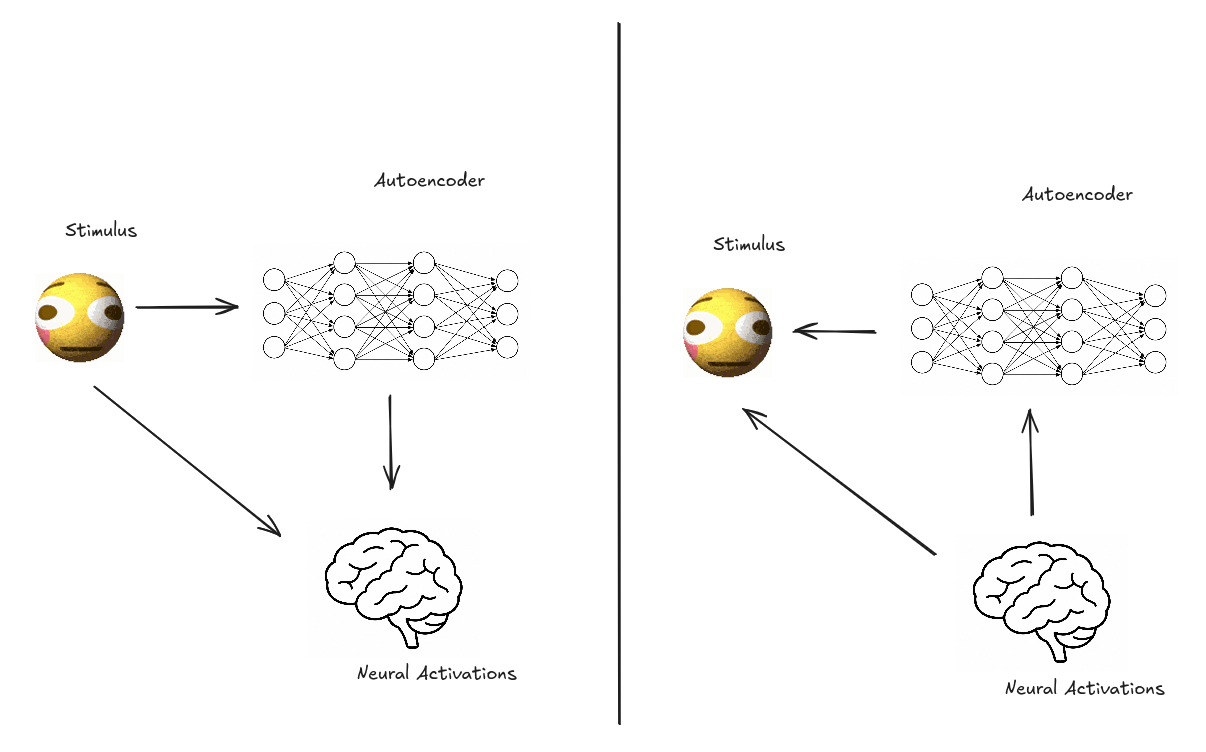
Telepathy Is (Algorithmically) Easy
Thought-sharing is easy given appropriate hardware. The main risks are psychosis and dissociative symptoms from identity disruption.Speech and text are extremely inefficient. For example, math textbooks are routinely more than one page long.This sucks! I want the entirety of human hard-science results to pass through my mind at least once. Someone learned each of those concepts, but they can't just copy their Understanding to me.[1]Or perhaps they can?If we can read and write enough neural state, then communication is a unusually friendly target for cognitive augmentation. Unlike most enhancements, it doesn't need (non-hardware) neuroscience breakthroughs.Humans are already exceptionally skilled at communication despite terrible bandwidth. By speaking while learning neuralese, we can use spoken language and feature engineering as training wheels to bootstrap telepathy.(To be clear, I'm talking about hardware and software to pass carefully-translated brain activity between people. It's not spooky.)Groups of experts could then share deep understanding in minutes-to-days; I'd wager that, with help from a mathematician, I could understand most of modern algebraic topology in a week instead of a year.This could go a few ways. We'll start with the most pessimistic.Say that we have absolutely no idea how to implement any algorithms which aren't scientifically replicated as of mid-2026.Neurotech labs already translate low-dimensional data for speech, movement, and audio-visual stimuli. So we take thousands of these decoders running at much higher resolution across brain surface, and start by training a model on stimuli from a VR headset and haptic suit.Left: computational graph for feature-engineered bootstrapping of telepathy model write component. The system learns to convert stimuli into neural activations. Right: same, for reading states.We have a basis. This can decode and re-encode simple stimuli. We now train the model to predict what text this person will write and