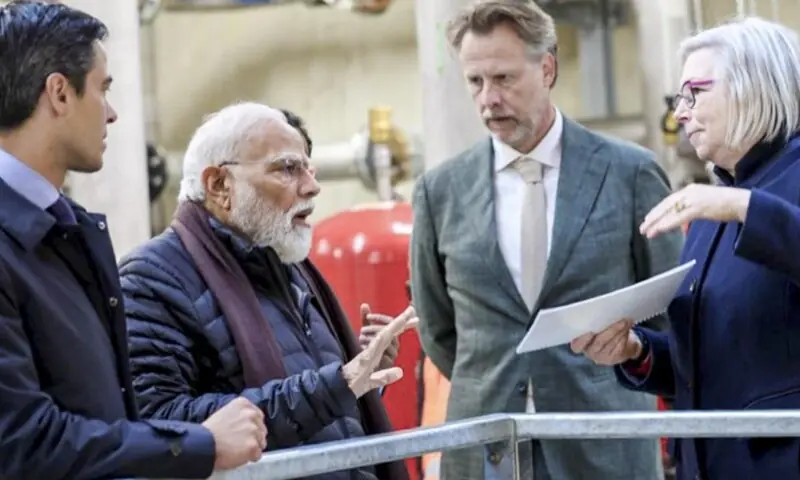
Modi govt’s tightly controlled script comes under Dutch journalistic scrutiny
Why this matters: local context for readers following news across Pakistan and the region.
During Indian Prime Minister Narendra Modi’s official visit to the Netherlands, a major controversy erupted during a press briefing in The Hague. While the official diplomatic objective of the visit was to elevate bilateral ties to a “strategic partnership” — heavily driven by trade, defence, and semiconductor technology — the exchange between Dutch journalists and an Indian diplomat underscored deep friction between Western journalistic standards and the Modi government’s tightly controlled public relations process. The incident As The Wire’s Devirupa Mitra has reported, ahead of the dinner for Modi hosted at Catshuis, the official residence of the Dutch prime minister just outside The Hague, PM Rob Jetten spoke with local reporters. Jetten was asked about aspects of Dutch-India relations. Jetten told reporters just before Modi arrived that there were concerns among the Netherlands and other EU member states about “developments in India” under Modi’s BJP. The issue was then forced directly onto the record by Ashwant Nandram, a journalist from the prominent Dutch newspaper De Volkskrant, who asked the following question to the Indian delegation during the official media briefing: “I’m a journalist for the Dutch newspaper, De Volkskrant. I have a few questions. In the Netherlands, there is a tradition that after such a visit, both prime ministers are available for questions. I wonder what the reason is that that is not the case today. Another thing is that today, during a statement of Prime Minister Jetten, he said that the Netherlands and the European Union are worried about, he said, press freedom and minority rights, among them the Muslim community and smaller communities. I wonder what the response is of the Indian government.” Faced with Nandram’s direct questioning, the MEA’s Secretary (West) Sibi George, deployed an assertive counter-narrative frequently used by the political leadership to neutralise international human rights critiques. The diplomat attempted