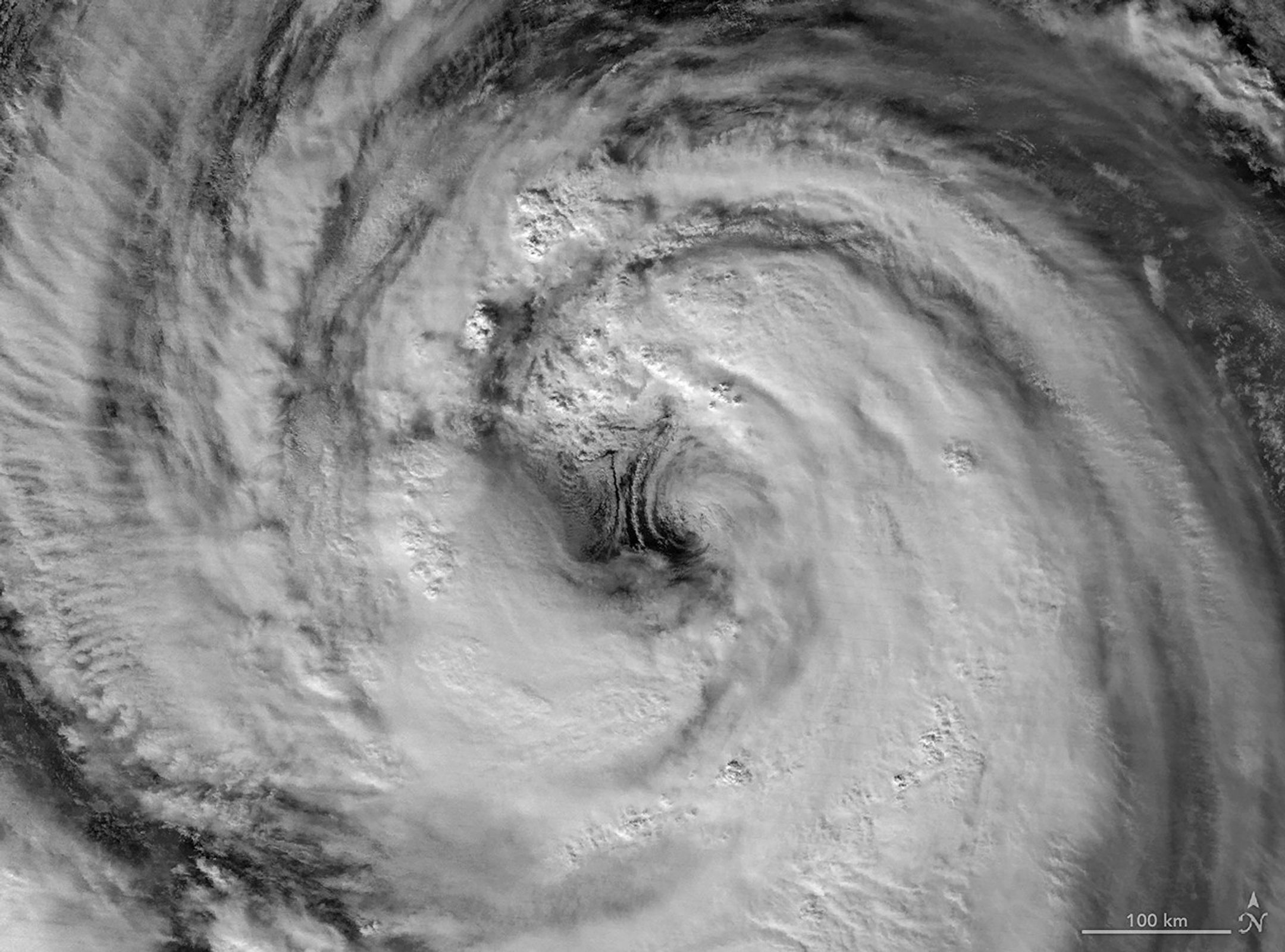
Typhoon Jangmi
Why this matters: new research or scientific developments with potential real-world impact.
Earth Observatory Science Earth Observatory Typhoon Jangmi Earth Earth Observatory Image of the Day EO Explorer Topics All Topics Atmosphere Land Heat & Radiation Life on Earth Human Dimensions Natural Events Oceans Remote Sensing Technology Snow & Ice Water More Content Collections Global Maps World of Change Articles Notes from the Field Blog Earth Matters Blog Blue Marble: Next Generation EO Kids Mission: Biomes About About Us Subscribe 🛜 RSS Contact Us Search From late May into early June 2026, a broad, slow-spinning storm churned north-northwest over the Philippine Sea toward southern Japan. Typhoon Jangmi’s rainbands unleashed torrential rainfall across a vast swath of the region, triggering flooding concerns in several areas. The VIIRS (Visible Infrared Imaging Radiometer Suite) on the Suomi NPP satellite captured this nighttime image (above) of the storm at about 16:40 Universal Time on May 30 (1:40 a.m. Japan Standard Time on May 31). Around that time, the typhoon produced sustained winds of 120 kilometers (75 miles) per hour, based on 1-minute averages reported by the Joint Typhoon Warning Center (JTWC). That’s equivalent to a category 1 storm on the Saffir-Simpson hurricane wind scale. The image shows a detailed view of the eyewall and eye, with a diameter that is on the larger end of the spectrum, according to Scott Braun, a research meteorologist at NASA’s Goddard Space Flight Center. There also appears to be some low-level rotation on the eastern side of the eye, producing features known as “mesocyclones” that are partially obscured by high-level clouds. Though they appear striking, the features are fairly typical, Braun noted. The second image shows a wider view of the same storm one day later. The VIIRS on the NOAA-20 satellite acquired this image at about 16:40 Universal Time on May 31 (1:40 a.m. Japan Standard Time on June 1), when the storm was a slightly stronger typhoon with sustained winds of 130 kilometers (80 miles) per hour. In bo