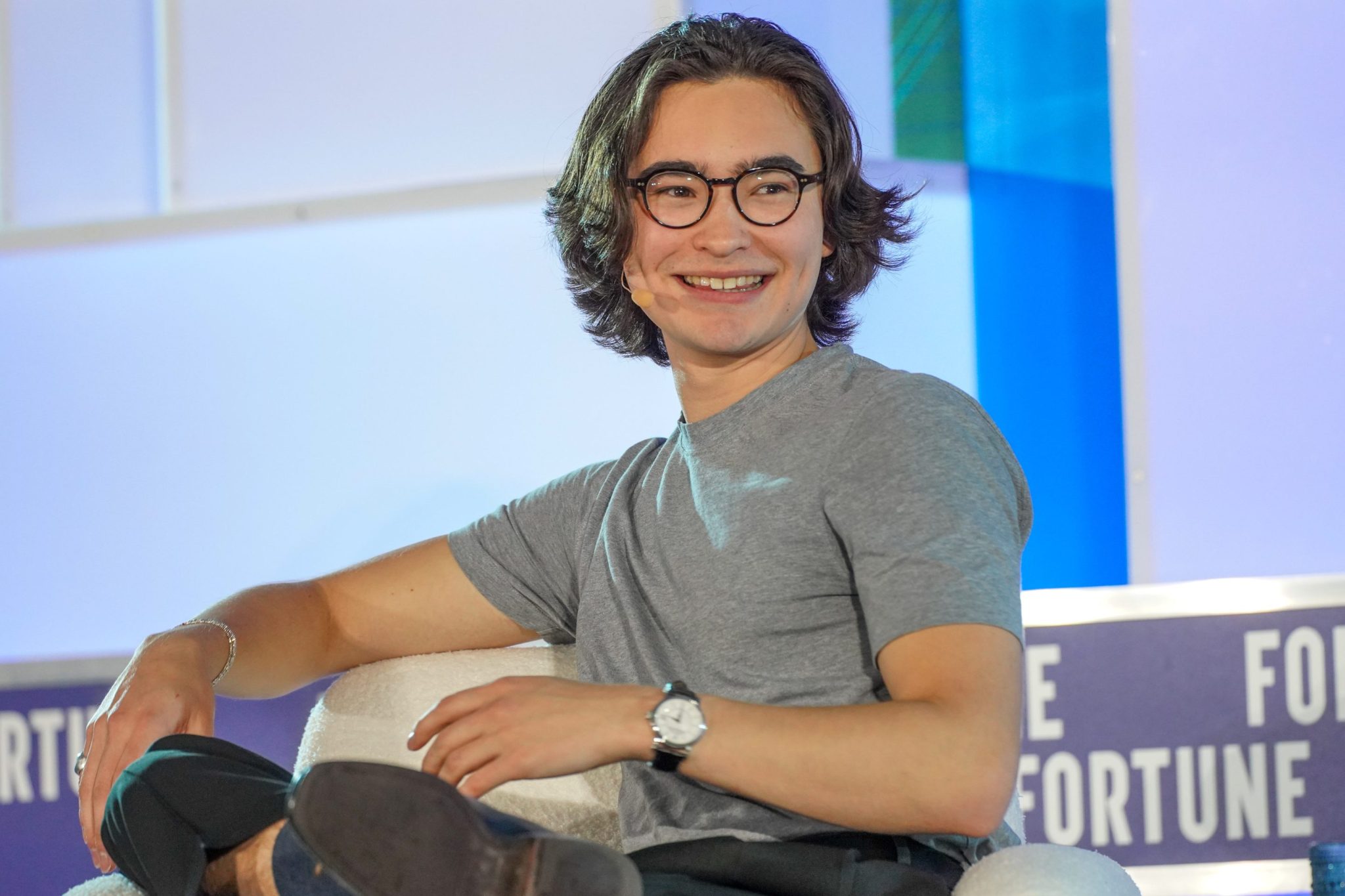
A 21-year-old cofounder’s sales pitch to clients begs them to question the company’s results: ‘Do not trust us. Do not trust our model’
Nearly 2 million New Yorkers voted in the city’s primary mayoral election. Aaru, a two-year-old AI startup, simulated all of those voters—agents built from the kind of data the company collects, like credit card purchasing history, food-delivery orders, and demographic records—and tried to predict how the votes would be cast. The simulation came within 2,000 votes of the final count. Aaru’s 21-year-old founder and president Ned Koh doesn’t care if you believe that. He said at Fortune’s Brainstorm Tech conference recently that while he lacks years of experience in enterprise sales and market research, he’s let the company speak for itself. “Our entire sales methodology is to go to a business and say, ‘Do not trust us. Do not trust our model,’” Koh said. “In fact, I hope you’re skeptical, because it means you’ll be a better customer in the long run.” Koh cofounded Aaru in March 2024, at 19, with Cameron Fink, then 18, and John Kessler, then 15 (and too young to sit on the board). The company organizes thousands of AI agents into statistically representative populations—each agent assigned an age, an income, a zip code, a gender, among other things—and surveys them in place of human respondents. The company begs a somewhat uncomfortable question: Are humans so pliable to conditioning, that you can predict their behavior using second-order data? The company builds AI to train and benchmark on what it calls “outcomes”: election results, purchase data, the things people do rather than the things they say. The outcomes are pretty spot on, though not always in the way clients anticipate. Aaru counts on clients’ incredulousness for the success of this framework. Prospects hand over an old survey—the people they polled, the questions they asked—and Aaru reruns it blind against the known result. The proof he cited: Ernst & Young, a partner of Aaru, which spent six months surveying 3,600 people across 30 countries for its global w