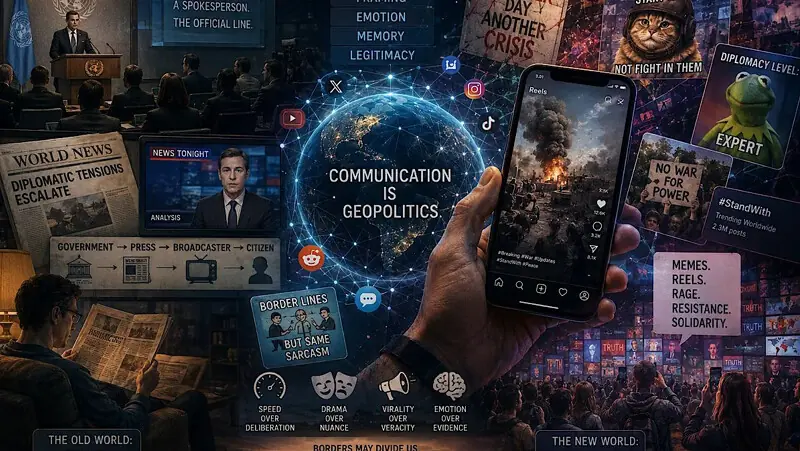
The end of one-way communication
Why this matters: local context for readers following news across Pakistan and the region.
THERE was a time when geopolitics moved through formal rooms. A state issued a statement. A spokesperson read from a prepared text. A newspaper carried the official line the next morning. A television anchor interpreted the event for the evening audience. The world seemed to travel through a recognisable chain of authority: government, press, broadcaster, citizen. That world has not disappeared, but it has been radically dethroned. Today, geopolitical communication no longer waits for the press briefing. It erupts through a phone screen, mutates into a meme, becomes a thirty-second reel, and is weaponised before official institutions have even finished drafting their response. In this new environment, communication is not merely the carrier of geopolitics. It is geopolitics. The struggle between nations is no longer only over territory, trade routes, military alliances, energy corridors or diplomatic blocs. It is also over perception, framing, emotion, memory and moral legitimacy. Traditional media has not become irrelevant, but it has lost its monopoly over first contact with reality. For many people, especially younger audiences, the first encounter with a war, coup, election, protest, climate disaster or diplomatic crisis is no longer a newspaper headline or a state broadcaster. Younger audiences are increasingly consuming news through platforms such as TikTok, Instagram, Reddit and X, placing greater trust in information from social media than older adults. In the contemporary media environment, many newsrooms resemble theatres of geopolitical emotion. The anchor is not merely a presenter but a performer. The studio is not just a space of analysis but a stage of confrontation. Every crisis becomes a spectacle. Every disagreement becomes a shouting match. Every adversary becomes a character. This has consequences. It simplifies complexity into combat, rewards certainty over nuance, and turns diplomacy into drama. In a tense geopolitical moment, communication can