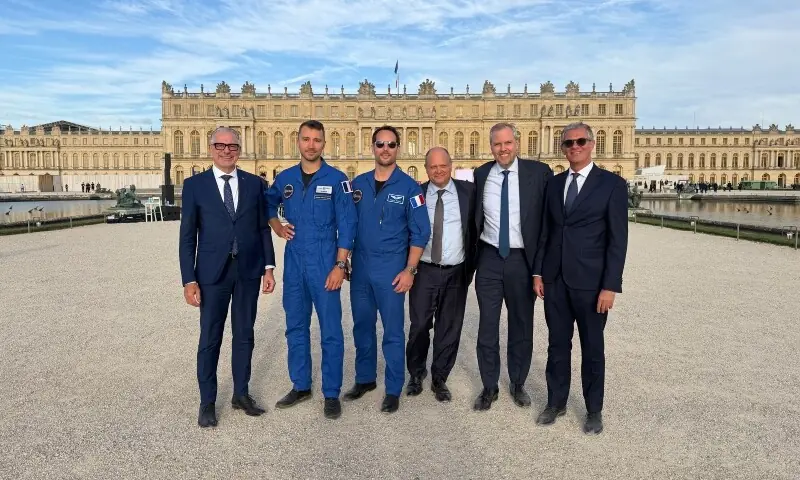
Vast astronaut mission kicks off commercial race to replace ISS
Why this matters: local context for readers following news across Pakistan and the region.
The race to replace the ageing International Space Station (ISS) is heating up after US company Vast announced a mission to fly an astronaut to its planned Haven-1 station next year. If the repeatedly delayed Haven-1 is launched into orbit as scheduled in early 2027, it will become history’s first commercial space station, beating out several competitors. It would also mark a post-ISS era for humanity’s presence in space, as the West seeks independence from Russian space operations due to the war in Ukraine. After a quarter of a century of continuous habitation, the ISS is scheduled to be deorbited in 2030. On Tuesday, Vast became the first aerospace company to announce a crewed mission to its future station. “This is an important milestone in a new era in crewed spaceflight that is less expensive — and less reliant on Russia,” Vast CEO Max Haot told AFP in an interview. ‘Attractive prices’ French astronaut Arnaud Prost “is joining us on the crew of the inaugural mission of what will be the world’s first operational commercial space station when it launches next year”, Haot said. On board Haven-1, Prost will be tasked with carrying out tests ahead of scientific experiments, which will be similar to those conducted on the ISS, he explained. The privately funded station will have a single module, compared to 16 currently on the ISS. During its three years in orbit, it will “host four two-week missions,” Haot said. Vast has bigger plans for its replacement. Haven-2 will eventually have nine modules, but the company plans to deploy them gradually over time. This will mean the modules cost “five to 10 times lower” than those for the ISS, which often exceeded a billion dollars, Haot said. “This will allow us to increase the number of crewed flights and offer more attractive prices to our customers,” he added. “We hope to launch three modules per year for our future station — and that at least one module will be launched by a European rocket.” The company aims to have four