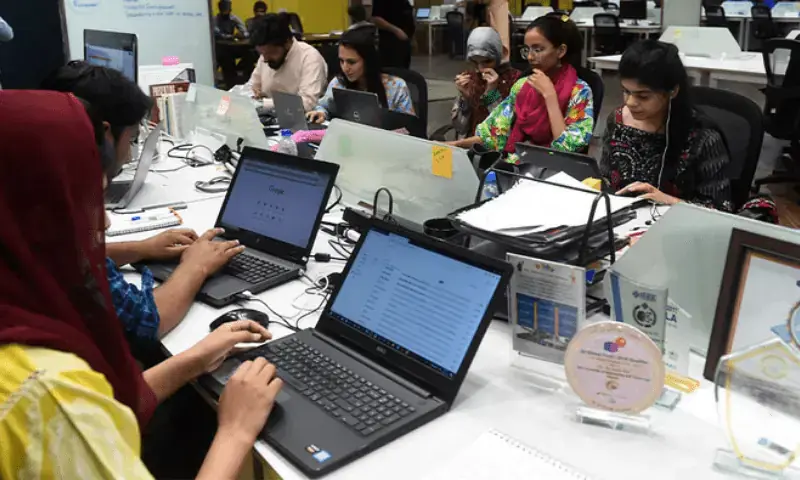
ECONOMIC SURVEY 2025-26: Digital economy grows as IT sector posts gains
Why this matters: local context for readers following news across Pakistan and the region.
According to the Economic Survey 2025-26, the outgoing fiscal year saw sweeping improvements in accessibility and connectivity. Cellular mobile services now cover 92pc of the population, with 3G and 4G signals reaching over 81pc of the country’s area. Broadband penetration has nearly doubled from 32.6pc in 2019. Telecom revenues reached Rs837bn in 9MFY26, bolstered by $567 million in sector investments. The industry contributed Rs285bn to the national exchequer through taxes and duties. Total telecom subscriptions, encompassing both mobile and fixed-line services, hit 207.22m in March. To further expand internet access, the National Assembly on Thursday approved the Pakistan Telecommunication (Reorganisation) (Amendment) Act, 2026. The legislation permits companies to lay optic fiber cables free of cost across any government-owned land and housing societies. This aligns with the National Fiberisation Plan, advanced by the Pakistan Telecommunication Authority and the Ministry of IT and Telecommunication, to support 5G and emerging digital services. During the fiscal year, the PTA also approved the adoption of Wi-Fi 7 in the 6 GHz band, positioning Pakistan among the leading Asia-Pacific nations to formally adopt the next-generation technology. The upgrade promises higher throughput and ultra-low latency for advanced applications like 8K streaming and industrial automation. Pakistan also bolstered its international connectivity. The country’s network currently relies on six submarine cable systems and on