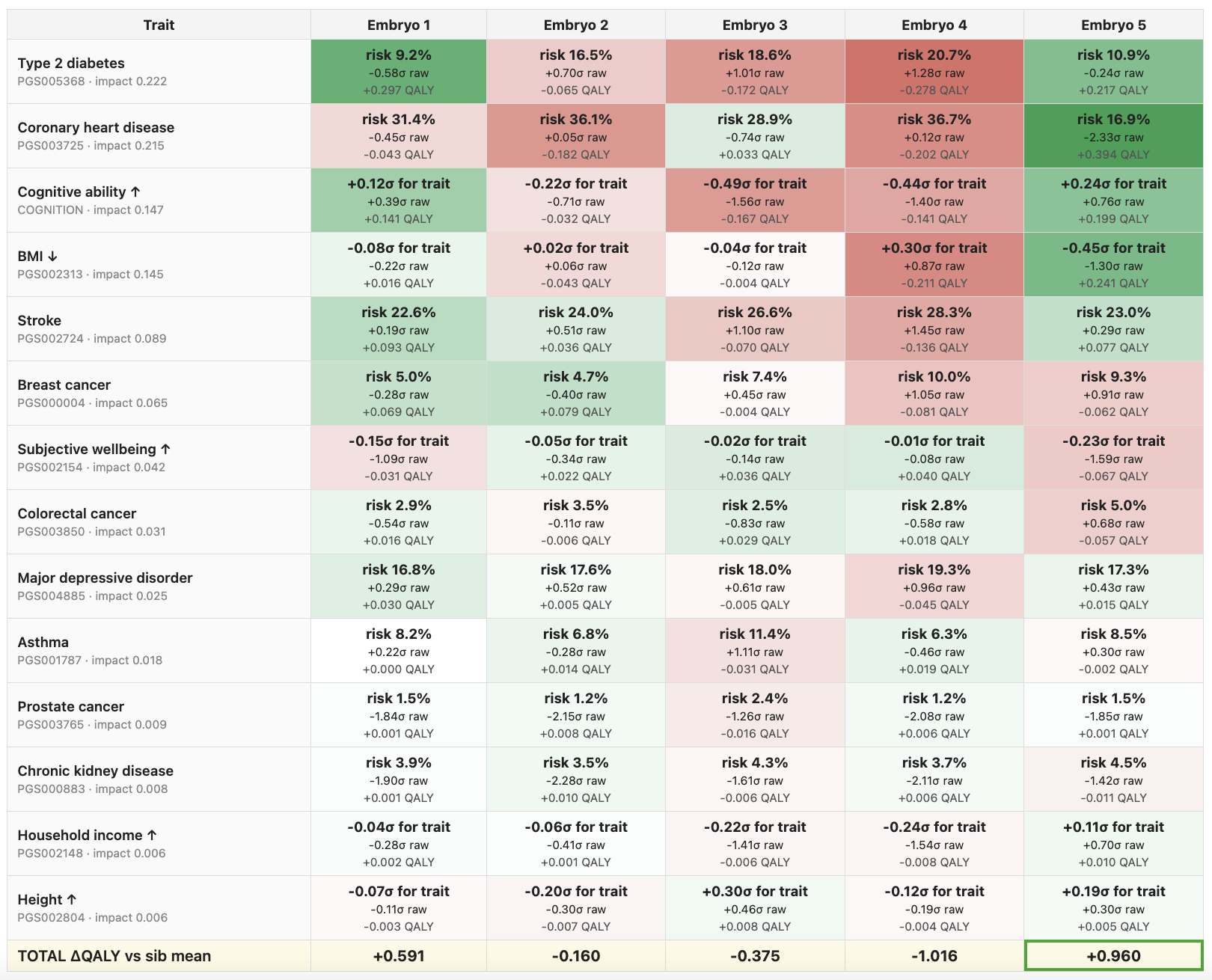
an open-source repo for embryo selection
I recently made this great repo for polygenic prediction and embryo selection which I want to share with people. I've wanted something like this for almost a decade, and it's so easy now that we have these superhuman coding models.Note that I also have this longer technical essay attached to the repo, as well as these slides (I think they're both very nice!)Let's look at how everything works now.Data My repo pulls in data for existing predictors from the pgs (polygenic score) catalog, and filters to the best weights for each feature using claude's best judgment (this worked better than using simpler heuristics like recency and dataset size). There are predictors for intelligence, height, and many disease traits. Across adults these correlate with measured phenotype at around 0.3, 0.65, and 0.15-0.3 after accounting for obvious confounders like sex and age, so pretty nontrivial.In addition to uploading those final prediction weights, researchers will also upload per-snp (single-nucleotide polymorphism) correlations for each trait. Remarkably, those open-source gwas (genome-wide association study) sumstats are sufficient to rederive state of the art predictors. The field has rallied around developing techniques like lassosum or LDpred or SBayesRC for learning pgs weights, each of which assumes that all you have access to is these gwas sumstats, along with population-level linkage-disequilibrium matrices encoding how frequently neighboring snp's occur together compared to chance. It's actually kind of a blessing, since you can go further and aggregate open-source gwas sumstats across biobanks, without ever getting formal portal access.I made a slightly improved intelligence predictor by combining the ~250k intelligence datapoints with the ~750k public education datapoints using this technique called MTAG, which is roughly equivalent to taking a linear combination of the intelligence and education predictors, with the weighting chosen to maximize intelligence prediction.