Analysis: Agriculture tax reform stalls at the farm gate
Why this matters: local context for readers following news across Pakistan and the region.
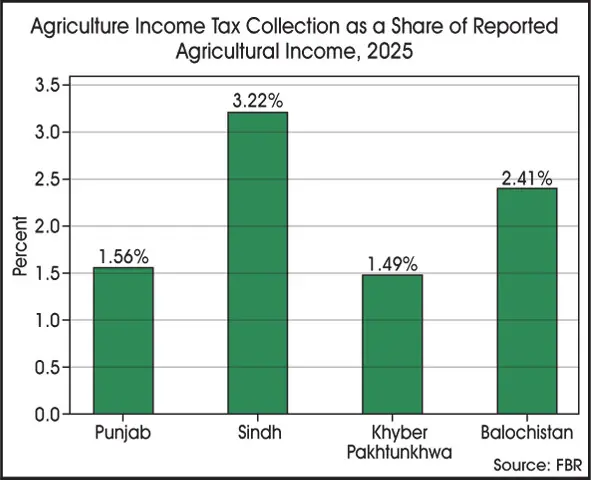
Source: FBR THE first year of Pakistan’s unified agriculture income tax regime has exposed a stark gap between policy ambition and revenue collection, with provincial tax authorities collecting barely 2 per cent of the agricultural income declared by taxpayers during fiscal year 2025-26. The figures raise fresh questions about the effectiveness of the landmark reform introduced last year under a fiscal restructuring programme backed by the International Monetary Fund. Despite a harmonised legal framework and uniform tax rates across all four provinces, provisional data shows that around 445,000 taxpayers declared Rs306 billion in agricultural income in tax year 2025, while provincial governments provisionally collected only Rs5.62bn in agriculture income tax (AIT) during the outgoing fiscal year. Structural weaknesses, weak enforcement, political considerations and the influence of large landowners continue to undermine the provinces’ ability to collect AIT. Although the four provinces agreed on a harmonised legal framework and tax rates, each has adopted a different approach to implementing the tax. Agriculture income tax collection equals barely 2pc of declared income For fiscal year 2026-27, Sindh has aligned its super tax on agricultural income with the federal regime while abolishing the advance tax provision. Punjab and Khyber Pakhtunkhwa have taken the opposite course. Punjab has instead increased advance tax rates, signalling a greater reliance on advance tax collection, while KP has abolished super tax on high-income earners and retained its zone-based fixed tax per acre system. Balochistan has yet to disclose its AIT policy for the new fiscal year, as the provincial government has not shared its budget white paper 2026-27 and other documents despite repeated requests. Former chief economist Dr Mohammad Ahmed Zubair said agricultural income taxation sits at the heart of Pakistan’s most entrenched political economy fault lines. Provincial governments are eff