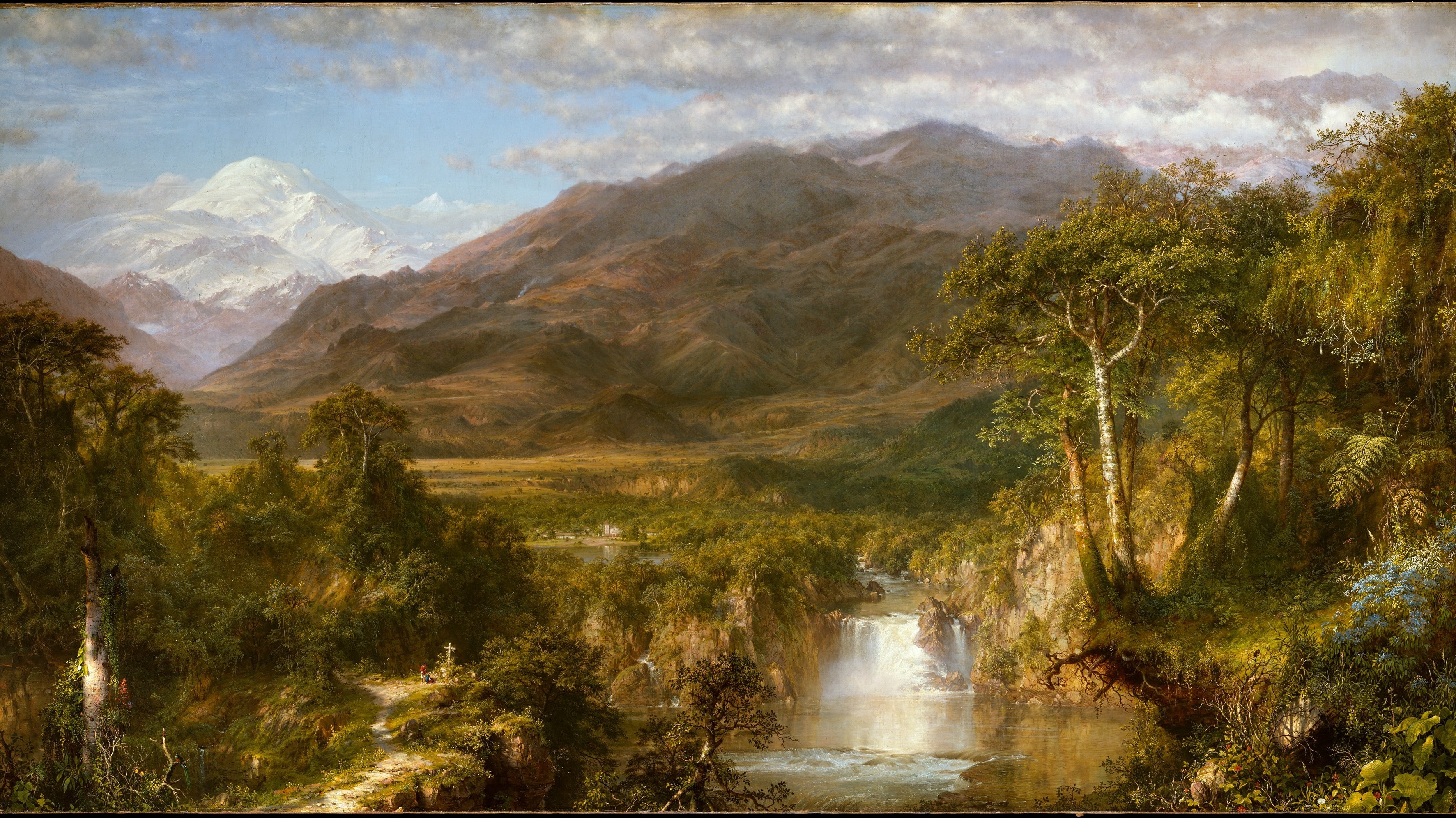
A Canvas as Big as the Country
Church’s pictures.” James wasn’t (in this instance) being spiteful. He was trying to sort out a real problem: What did the work of America’s preeminent painter actually mean? Serious art is supposed to mean something—that’s a given—but really, what is there to say about Frederic Church’s Valley of Santa Ysabel, New Granada? You see distant mountains, an effulgent sky reflected in placid water, lots of greenery, and tiny people not doing much besides establishing the scale of an adjacent palm. You can feel the stillness and weight of the air. “Why not accept this lovely tropic scene as a very pretty picture,” James asked, “and have done with it?” A century and a half later, we’re still stumped.Church, whose 200th birthday rolled around in May, was America’s first art star. He won accolades in England and a silver medal at the 1867 Exposition Universelle in Paris at a time when “American painting” was still an oxymoron among many cognoscenti. In city after city, people queued up in the tens of thousands and paid good money to stand in front of his pictures. Queen Victoria secured a private viewing of The Heart of the Andes. Audiences marveled at the exactitude, the passage of light, the almost palpable presence of a distant place. “He ranges with a steady eye and an unwavering hand,” The New York Times intoned. Church’s death, in 1900, was marked by a six-month retrospective at the Metropolitan Museum of Art, an institution he had helped found, housed in the great public park for which he had served as a commissioner.By then, however, the world was moving on. In the years that followed, American landscape painting was shuffled off to storage to make room for modernism, and paintings like Church’s, with their glassy finishes and profuse detail, came to seem the embodiment of fuddy-duddy. When Olana, Church’s visionary 250-acr