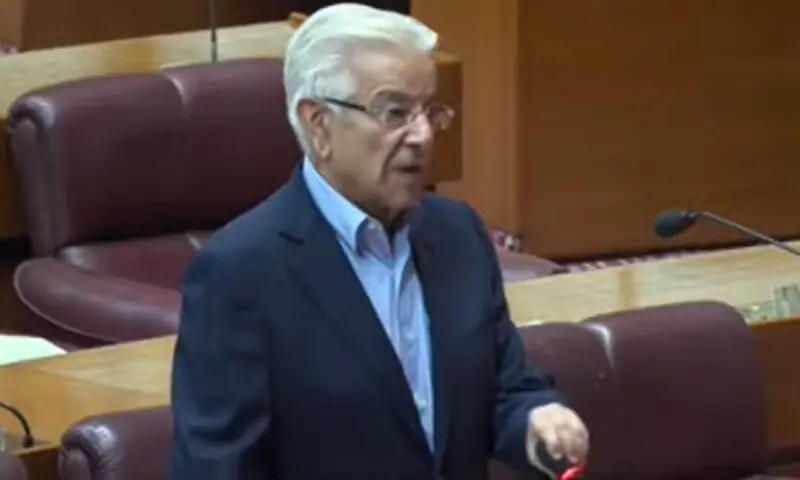
Pakistan's economy has left the ICU, says Khawaja Asif
Why this matters: local context for readers following news across Pakistan and the region.
Defence Minister Khawaja Asif said on Tuesday that Pakistan’s economy had left the “intensive care unit”. He made the remarks while speaking in the National Assembly, during which he also talked about insecurity in Balochistan and Pakistan’s role in brokering the agreement with the United States and Iran. “When we [presented] the first budget, we were insolvent. There was always the danger that we would default today or tomorrow. The International Monetary Fund (IMF) bailed us out with strict conditions, which we are now bearing but we have become solvent. Our economy is breathing; it has left the ICU,” he said. “I will not say that we are reaching the stars but our trajectory bears witness that in one or two years … we will reach a place where Pakistan achieves a growth rate of 6-7 per cent,” he said. He said that there were multiple “inbuilt taxes” in the country, adding that “we have to get rid of all these things to become solvent”. He said that the tax rate should be brought to a level where the entire country was ready to pay it instead of becoming prohibitive. “Why should we force people to search for ways to evade taxes? We should bring taxes to a level where a conducive environment is created, where people pay taxes and do so with pride,” he said. In his remarks, the defence minister also addressed the issue of terrorism in Balochistan, saying that the situation had not been created “yesterday or the day before” but that lots of people had contributed to it. “I will not take names … but it is everyone’s responsibility,” he said, stressing that if Balochistan’s roads were not safe, the “collective responsibility” also lay with the House. “I can accuse my brothers on that side of the aisle about what happened in their time, and they can accuse me, but it goes back to the 50s,” he noted, adding, “If we want to search for a solution, we have to search for it collectively.” Talking about Islamabad’s role in brokering the agreement between the US and Iran, Asif s